The Stone–Weierstrass theorem is a cornerstone of approximation theory: it turns a few structural properties of a family of functions into the ability to approximate every continuous function. It explains the density of polynomials and Fourier modes, and provides a route to universality for neural networks—even two-layer networks. It also plays a central role in my recent work with Takashi Furuya and Maarten de Hoop on attention universality over an infinite-dimensional space of contexts [3].
The hypothesis that often looks most restrictive is stability under products. Multiplying two polynomials gives another polynomial, but multiplying two ReLU networks generally does not give a ReLU network. Fortunately, exact multiplication is unnecessary: it is enough that products belong to the uniform closure of the class. This elementary consequence of the usual theorem is worth keeping in mind.
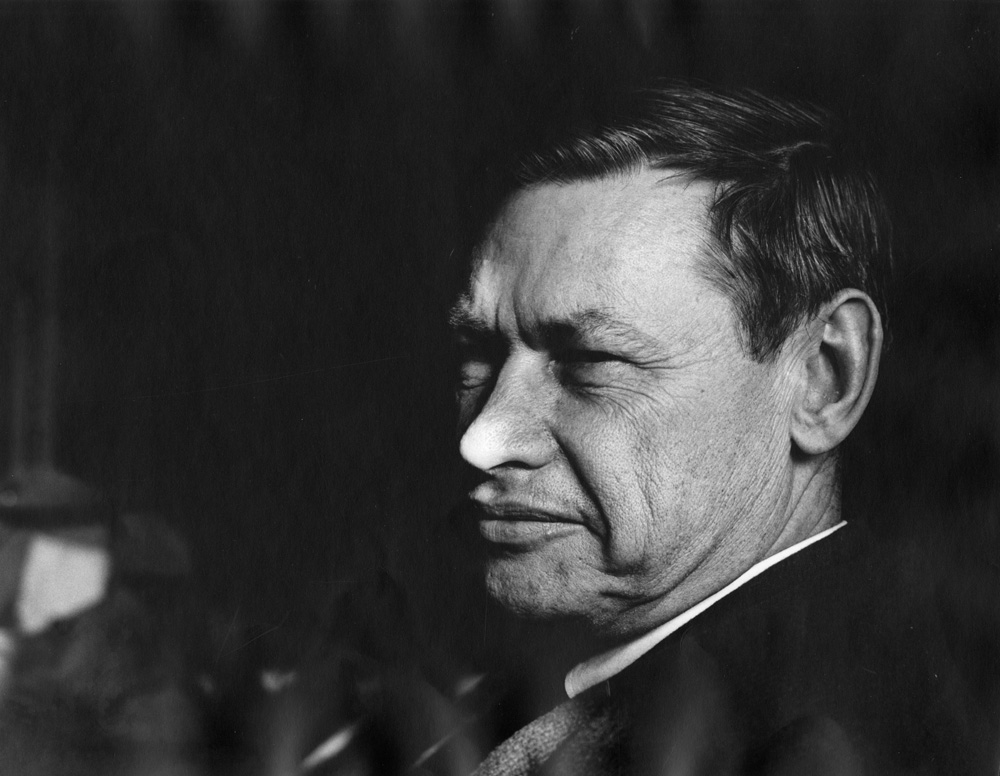
Marshall H. Stone
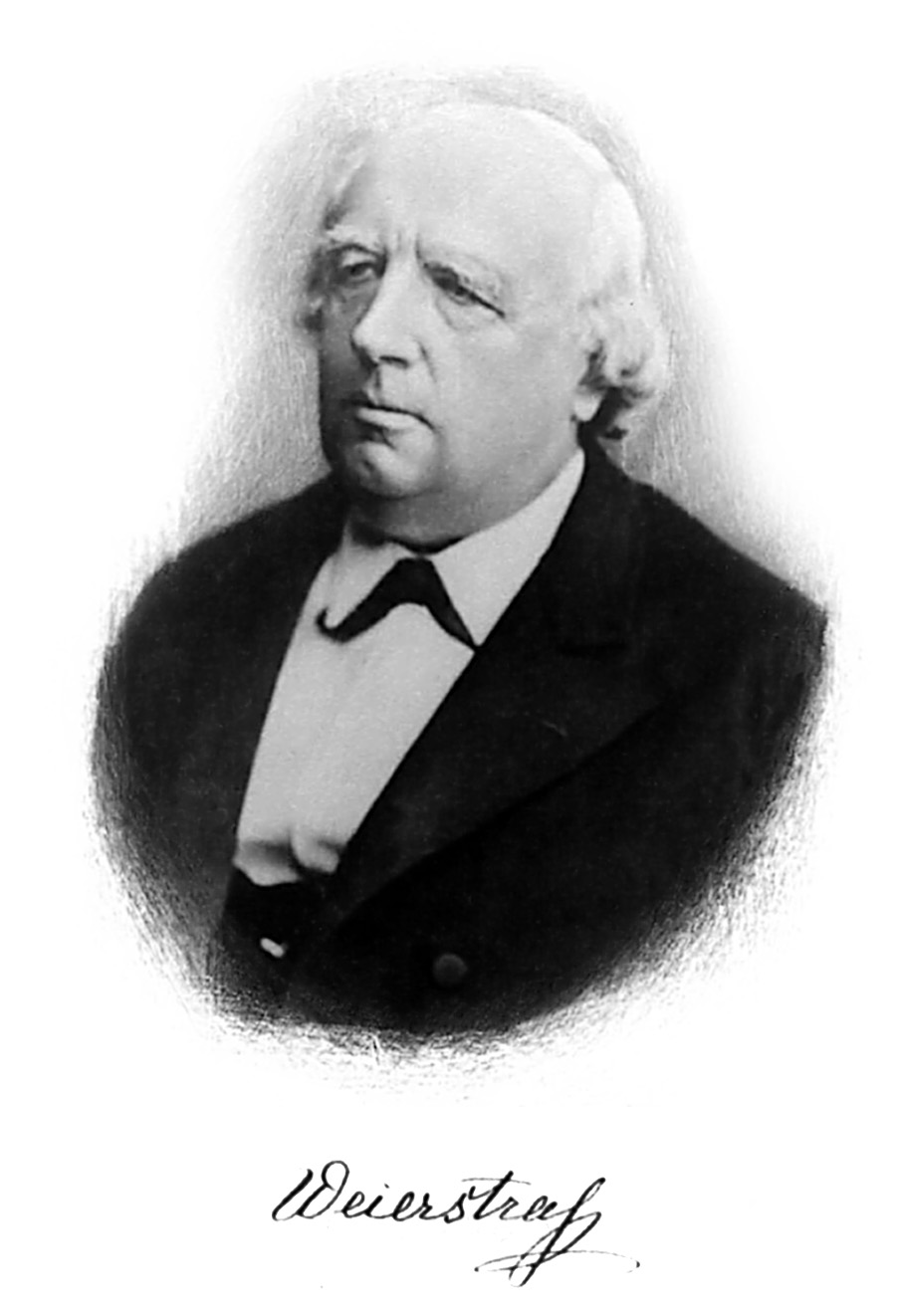
Karl Weierstrass
Weierstrass: Smithsonian Institution Libraries, via Wikimedia Commons, public domain.
The classical theorem
Let \(K\) be a compact Hausdorff space, and let \(C(K,\mathbb R)\) denote its real-valued continuous functions, equipped with the uniform norm
\[\|f\|_\infty=\sup_{x\in K}|f(x)|.\]A family \(\mathcal A\) separates points if, whenever \(x\ne y\), some \(f\in\mathcal A\) satisfies \(f(x)\ne f(y)\). It is a unital algebra if it contains the constant function \(1\) and is stable under linear combinations and pointwise products.
Theorem 1 (Stone–Weierstrass). A unital subalgebra \(\mathcal A\subset C(K,\mathbb R)\) that separates points is uniformly dense:
\[\overline{\mathcal A}=C(K,\mathbb R).\]Here and below, the bar means closure for \(\|\cdot\|_\infty\). Thus, for every continuous target and every positive error tolerance, there is one member of the family approximating that target everywhere on \(K\) [1].
Three familiar examples illustrate the hypotheses:
- Polynomials. On any compact \(K\subset\mathbb R^d\), restrictions of real polynomials form a unital algebra. Coordinate functions separate points, so polynomials are dense in \(C(K,\mathbb R)\).
- Fourier approximation. On the torus \(\mathbb T^d\), real trigonometric polynomials form a unital algebra and separate points. They therefore approximate every continuous periodic function uniformly. This is a density statement, not a claim that the ordinary Fourier partial sums of every continuous function converge uniformly.
- Exponential networks. On a compact \(K\subset\mathbb R^d\), the finite real linear combinations of \(x\mapsto e^{w\cdot x}\) form a unital algebra: \(w=0\) gives constants, and \(e^{u\cdot x}e^{v\cdot x}=e^{(u+v)\cdot x}\). They separate points because the exponential is injective and linear forms separate points. Thus one-hidden-layer networks with exponential activation are uniformly dense in \(C(K,\mathbb R)\).
An algebra only in the closure
Here is the useful reformulation.
Theorem 2 (approximate products suffice). Let \(\mathcal F\subset C(K,\mathbb R)\) be a real linear subspace containing \(1\) and separating points. Suppose that
\[f,g\in\mathcal F\quad\Longrightarrow\quad fg\in\overline{\mathcal F}.\]Then
\[\boxed{\overline{\mathcal F}=C(K,\mathbb R).}\]The assumption says that, for every \(f,g\in\mathcal F\) and every \(\varepsilon>0\), there is \(h\in\mathcal F\) such that \(\|h-fg\|_\infty<\varepsilon\). It does not require the exact product to be representable.
Proof: the closure is an algebra
Set \(\mathcal A=\overline{\mathcal F}\). It is a closed linear space containing constants and separating points. For \(f,g\in\mathcal A\), choose \(f_n,g_n\in\mathcal F\) converging uniformly to \(f,g\). Multiplication is continuous in the uniform norm:
\[\|f_ng_n-fg\|_\infty \leq\|f_n\|_\infty\|g_n-g\|_\infty +\|f_n-f\|_\infty\|g\|_\infty\longrightarrow0.\]Each \(f_ng_n\) belongs to \(\mathcal A\) by assumption, so \(fg\in\mathcal A\) because \(\mathcal A\) is closed. Thus \(\mathcal A\) is a unital algebra. The classical theorem makes it dense in \(C(K,\mathbb R)\); since it is already closed, it equals that space. \(\square\)
More generally, one can start with any family whose closure is a unital, point-separating algebra. The linear-space formulation above is simply convenient for applications. The distinction is between exact algebraic operations in the model class and operations that can be approximated arbitrarily well.
It even suffices to approximate squares, thanks to polarization:
\[fg=\frac{(f+g)^2-(f-g)^2}{4}.\]Universality for ReLU networks
Theorem 2 gives a simple proof of universality for deep ReLU networks: instead of requiring the network class to be stable under products, we only need to approximate those products. The construction reduces to one-dimensional interpolation of the square function.
Let \(K\subset\mathbb R^d\) be compact and write \(\sigma(t)=\max(t,0)\). Consider the class \(\mathcal N\) of scalar-valued, finite feed-forward ReLU networks, with biases and an affine output layer. For now, both width and depth may be any finite size.
These networks are continuous and piecewise affine. On \(K=[-1,1]\), for example, the identity function is a ReLU network, but its square is not: no finite piecewise-affine function agrees with \(x^2\) on an interval. So \(\mathcal N\) is not, in general, an algebra.
The proof of universality nevertheless has a simple plan. A one-dimensional linear spline approximates the square function. ReLU represents such splines exactly. Polarization then produces an approximate multiplier, which we can append to any two networks. This puts their product in the closure, where Stone–Weierstrass applies. No neural-network universality theorem is needed as an input to this argument.
Proposition 1. Finite ReLU networks with unrestricted width and depth are uniformly dense:
\[\boxed{\overline{\mathcal N}=C(K,\mathbb R).}\]Proof: splines and an approximate multiplier
Constants, linear combinations, and separation. Networks can run in parallel and their outputs can be combined by an affine readout. Networks of different depths can be padded using the identity \(t=\sigma(t)-\sigma(-t)\). Hence \(\mathcal N\) is a vector space containing constants. It contains each coordinate function,
\[x_j=\sigma(x_j)-\sigma(-x_j),\]so it separates points of \(K\).
Approximate multiplication. Fix \(f,g\in\mathcal N\) and choose \(R>0\) with \(\|f\|_\infty,\|g\|_\infty\leq R\). Given \(\delta>0\), linearly interpolate \(t^2\) on a sufficiently fine partition of \([-2R,2R]\). The resulting spline \(q_\delta\) satisfies
\[\sup_{|t|\leq2R}|q_\delta(t)-t^2|\leq\delta.\]Indeed, on an interval \([a,b]\), the interpolant minus \(t^2\) is \((t-a)(b-t)\), which is at most \((b-a)^2/4\). Every such spline has a finite hinge representation
\[q_\delta(t)=a+bt+\sum_{j=1}^N c_j\sigma(t-\tau_j),\]where the coefficients \(c_j\) are its slope changes at the knots \(\tau_j\). Thus it is exactly a one-hidden-layer ReLU network; the linear term can also be represented using two ReLU units.
Define
\[m_\delta(u,v)=\frac{q_\delta(u+v)-q_\delta(u-v)}{4}.\]| For $$ | u | , | v | \leq R$$, the two spline errors give |
Run \(f\) and \(g\) in parallel, then apply \(m_\delta\). This is still a finite ReLU network \(h_\delta=m_\delta(f,g)\), and
\[\|h_\delta-fg\|_\infty\leq\frac{\delta}{2}.\]Therefore \(fg\in\overline{\mathcal N}\). The closure theorem yields the claim.
The networks themselves cannot multiply exactly, but their closure can.
Two-layer networks
The preceding result is weaker than necessary: the same universality holds with just two layers, meaning one ReLU hidden layer followed by an affine readout [2]. The product construction can increase depth, so it does not establish this stronger statement. To keep a single hidden layer, we will construct the approximation directly, using the exponential networks from the first section.
Consider arbitrary-width networks of the form
\[s(x)=a+\sum_{j=1}^N c_j\sigma(w_j\cdot x+b_j).\]The coefficients and input weights may have either sign. This is the ordinary ReLU class; the positivity constraints of ICNNs are not imposed here.
Proposition 2. These two-layer networks, with arbitrary width, are uniformly dense in the continuous functions on the compact domain.
Proof: exponential networks and explicit linear interpolation
Step 1: approximate by an exponential network. Let \(f\in C(K,\mathbb R)\) and \(\varepsilon>0\). By the exponential-algebra example above, choose
\[E(x)=\sum_{j=1}^J a_j e^{w_j\cdot x}, \qquad \|f-E\|_\infty<\frac{\varepsilon}{2}.\]Put
\[A=\sum_j|a_j|,\qquad R=\max_j\sup_{x\in K}|w_j\cdot x|.\]Compactness makes \(R\) finite. If \(A=0\) or \(R=0\), \(E\) is constant on \(K\) and already has a shallow ReLU representation. Otherwise, every exponential in \(E\) is evaluated on the explicit interval \([-R,R]\).
Step 2: interpolate the exponential on that interval. Choose an integer \(M\geq1\) and let \(h=2R/M\). The knots, for \(0\leq k\leq M\), and interval slopes, for \(0\leq k<M\), are
\[\begin{aligned} t_k&=-R+kh,\\ d_k&=\frac{e^{t_{k+1}}-e^{t_k}}{h}. \end{aligned}\]With slope jumps \(c_k=d_k-d_{k-1}\) for \(1\leq k<M\), the linear interpolant of \(e^t\) at these knots has the explicit ReLU formula
\[\begin{aligned} q_M(t)&=e^{-R}+d_0(t+R)\\ &\quad+\sum_{k=1}^{M-1}c_k\sigma(t-t_k). \end{aligned}\]Its slope on \([t_k,t_{k+1}]\) is \(d_k\), so it agrees with \(e^t\) at every knot.
Lemma 1 (interpolation error). On \([-R,R]\),
\[0\leq q_M(t)-e^t\leq\frac{e^R h^2}{8}.\]Proof of Lemma 1: bound the curvature on each interval
Convexity of the exponential gives the lower bound. Since \(e^t-(e^R/2)t^2\) is concave on \([-R,R]\), it lies above its chord on each interval \([a,b]=[t_k,t_{k+1}]\). Writing \(D(t)=q_M(t)-e^t\), rearranging this chord inequality gives
\[\begin{aligned} D(t) &\leq\frac{e^R}{2}(t-a)(b-t)\\ &\leq\frac{e^R h^2}{8}. \end{aligned}\]Step 3: replace each exponential ridge by its spline. Define
\[S_M(x)=\sum_{j=1}^J a_j q_M(w_j\cdot x).\]Every nonlinear term is a single ReLU ridge \(\sigma(w_j\cdot x-t_k)\). The remaining terms combine into one affine function \(v\cdot x+c\), which can be written using two additional hidden units and the output bias:
\[v\cdot x+c=\sigma(v\cdot x)-\sigma(-v\cdot x)+c.\]Thus \(S_M\) has one hidden layer, with at most \(J(M-1)+2\) ReLU units. Lemma 1 gives
\[\begin{aligned} \|S_M-E\|_\infty &\leq\frac{Ae^R h^2}{8}\\ &=\frac{Ae^R R^2}{2M^2}. \end{aligned}\]For example, take
\[M=\max\left\{1, \left\lceil R\sqrt{\frac{Ae^R}{\varepsilon}}\right\rceil \right\}.\]Then \(\|S_M-E\|_\infty\leq\varepsilon/2\), and the triangle inequality gives \(\|f-S_M\|_\infty<\varepsilon\). This proves universality without increasing the depth. \(\square\)
The exponential class supplies the algebra; explicit one-dimensional interpolation replaces each of its units by ReLUs. Width grows with the desired accuracy, while the number of layers stays at two.
Attention and infinite-dimensional inputs
In our work with Takashi Furuya and Maarten de Hoop [3], a context is a probability measure \(\mu\) on a compact token domain \(\Omega\subset\mathbb R^d\). The input is \((\mu,x)\in\mathcal P(\Omega)\times\Omega\), a compact space for weak convergence of measures, and generally infinite-dimensional.
For unmasked attention, we prove uniform approximation of continuous in-context maps by a single transformer, simultaneously across all context sizes, including non-atomic measures. The proof builds a point-separating algebra from elementary attention features, applies Stone–Weierstrass, then approximates its products with neural networks. It is the same useful principle: exact multiplication can belong to the proof’s auxiliary algebra, while the architecture only needs to approximate it.
References
[1] Marshall H. Stone. The Generalized Weierstrass Approximation Theorem. Mathematics Magazine 21 (1948), 167–184 and 237–254. Part I · Part II.
[2] Moshe Leshno, Vladimir Ya. Lin, Allan Pinkus, and Shimon Schocken. Multilayer feedforward networks with a nonpolynomial activation function can approximate any function. Neural Networks 6(6), 861–867 (1993). Paper · Author-hosted PDF.
[3] Takashi Furuya, Maarten V. de Hoop, and Gabriel Peyré. Transformers are Universal In-context Learners. ICLR (2025). Paper · Proceedings.