These forthcoming posts are shared as alpha previews. Their content may evolve before the finished articles appear on the blog.
Find a post
Search published articles and forthcoming alpha previews together.
Search titles, keywords, and summaries. Accents and capitalization do not matter.
Loading search… The article list remains available below.
Optimal transport
 Duality & geometry
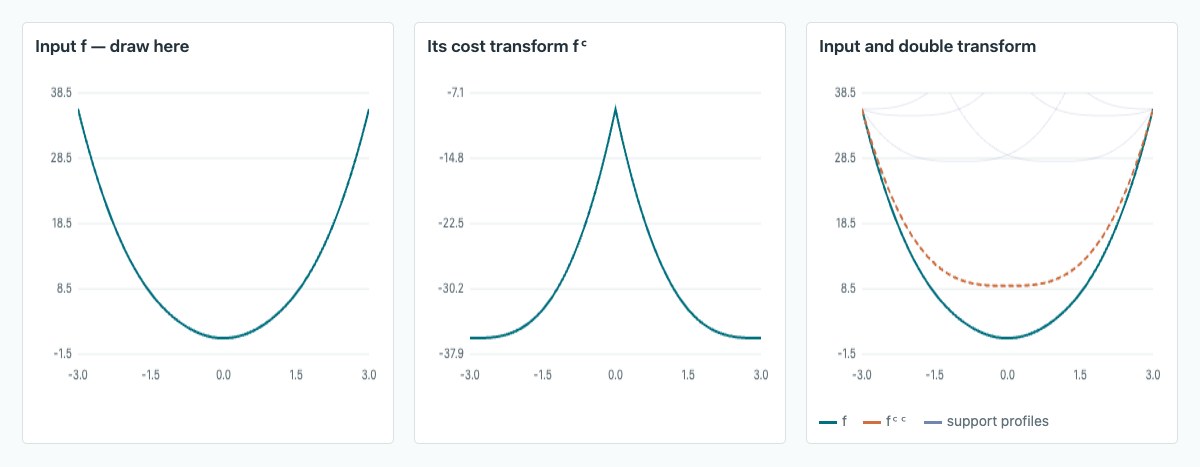
c-transform as a generalized Legendre transform
Which supporting shapes survive averaging? Cost transforms, two explicit counterexamples, and the surprising case of a round sphere.
 Learning a ground metric
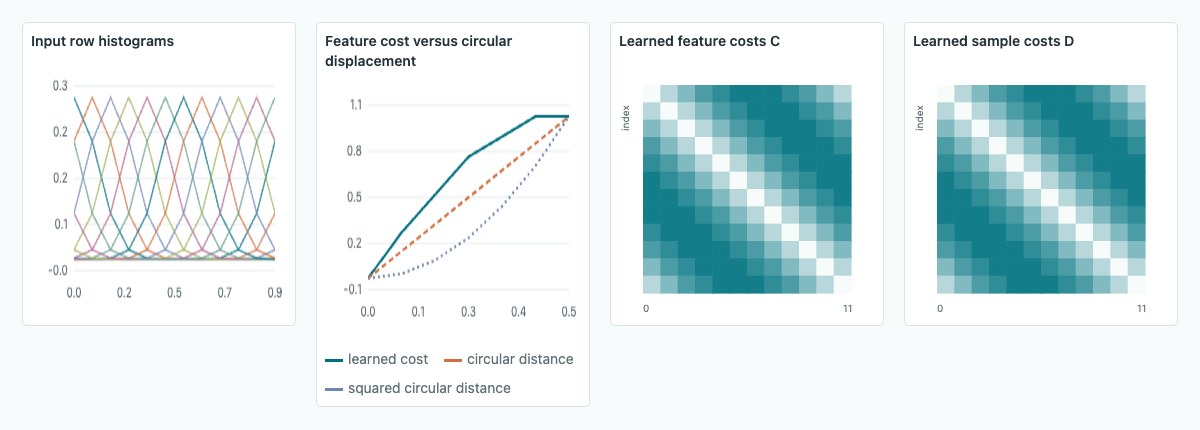
Wasserstein singular vectors
Let sample and feature distances learn one another, with a fixed-point proof and exact transport experiments on translated and rescaled bumps.
 Spectral geometry & robust transport
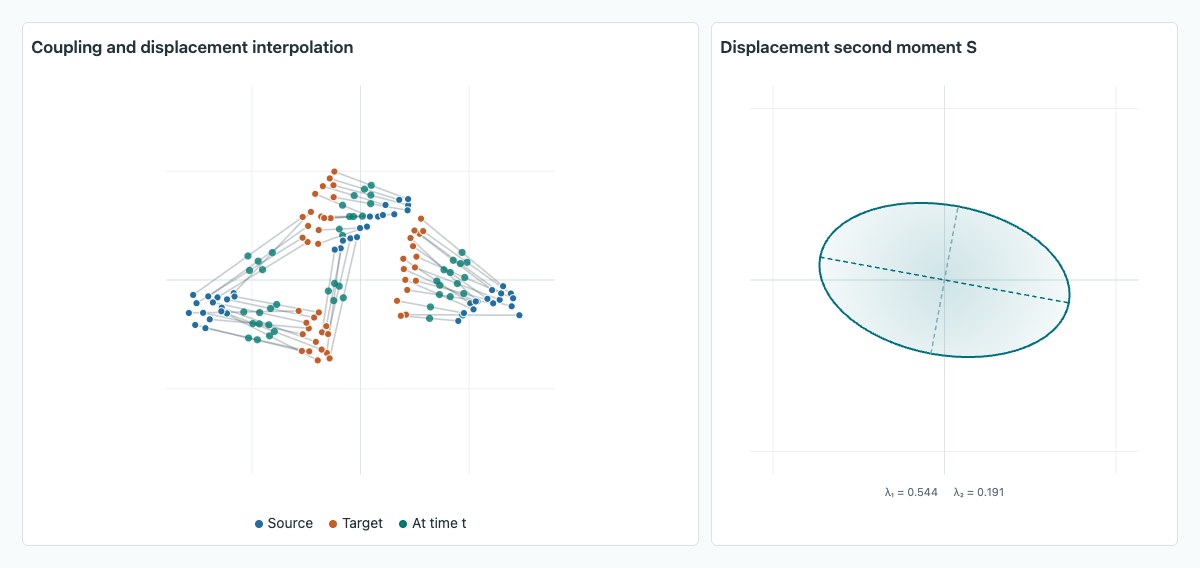
Spectral Wasserstein distances
Measure the directions of displacement, recover an adversarial quadratic cost and a dynamic action, and explore Schatten exponents down to one half.
 Entropic transport & convergence
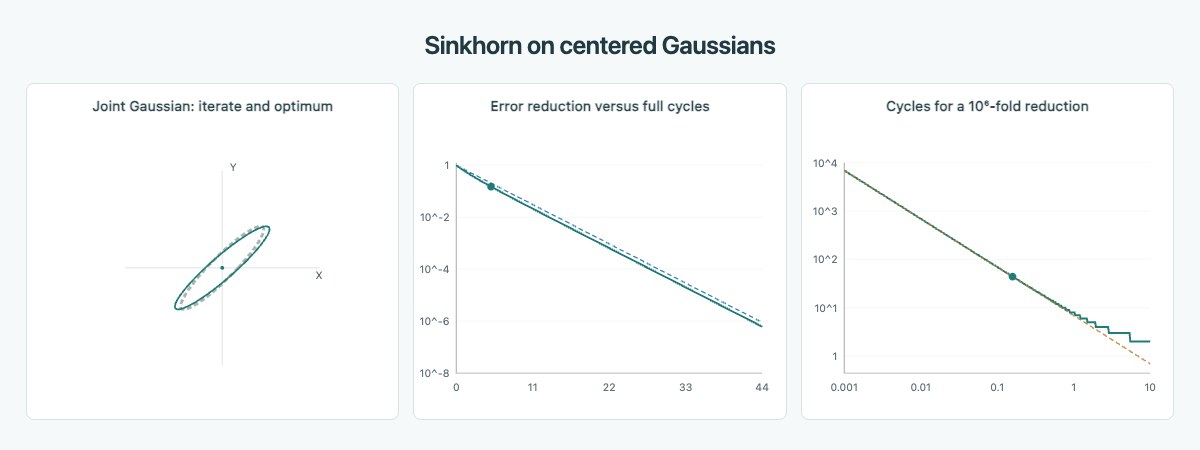
Sinkhorn on Gaussians
A closed covariance recursion gives an exact scalar convergence rate and reveals how entropic temperature controls the slowdown.
 One-dimensional transport
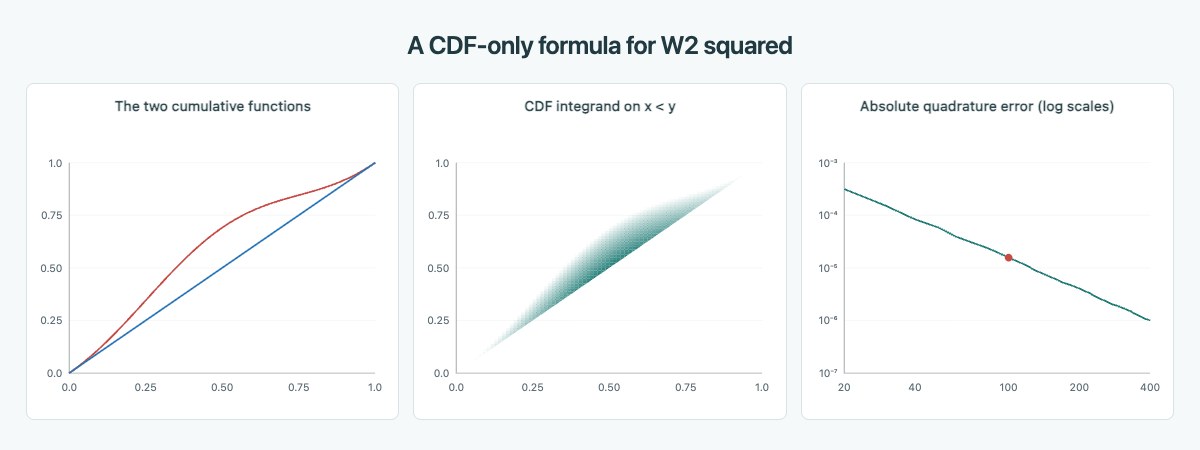
Wasserstein distance without quantiles
A triangle-area identity expresses quadratic transport directly through cumulative distribution functions.
 Geometry & combinatorics
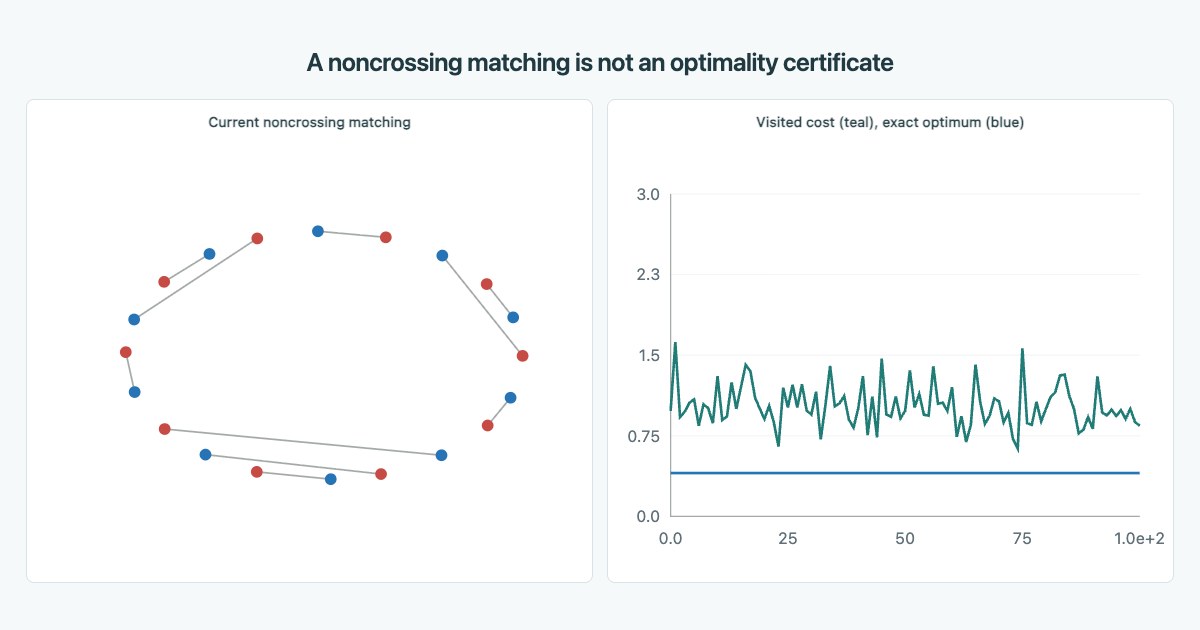
Optimal Planar Matching and Crossings
Uncrossing improves Euclidean length, but a Catalan-sized family of matchings still remains to explore.
 Conditional means
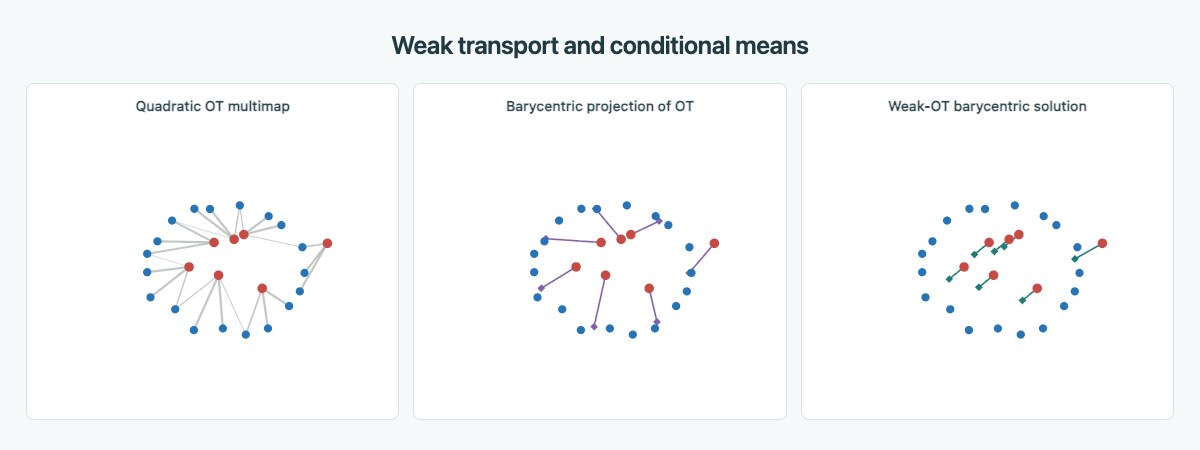
Weak transport and convex order
Pay only for the movement of conditional means, and discover a projection onto mean-preserving spreads.
Flows and geometry
Logarithmic Sobolev is Wasserstein P–L
Fisher information is an entropy gradient norm. A finite-length argument proves convergence of distributions without assuming convexity.
 Moving a prescribed density
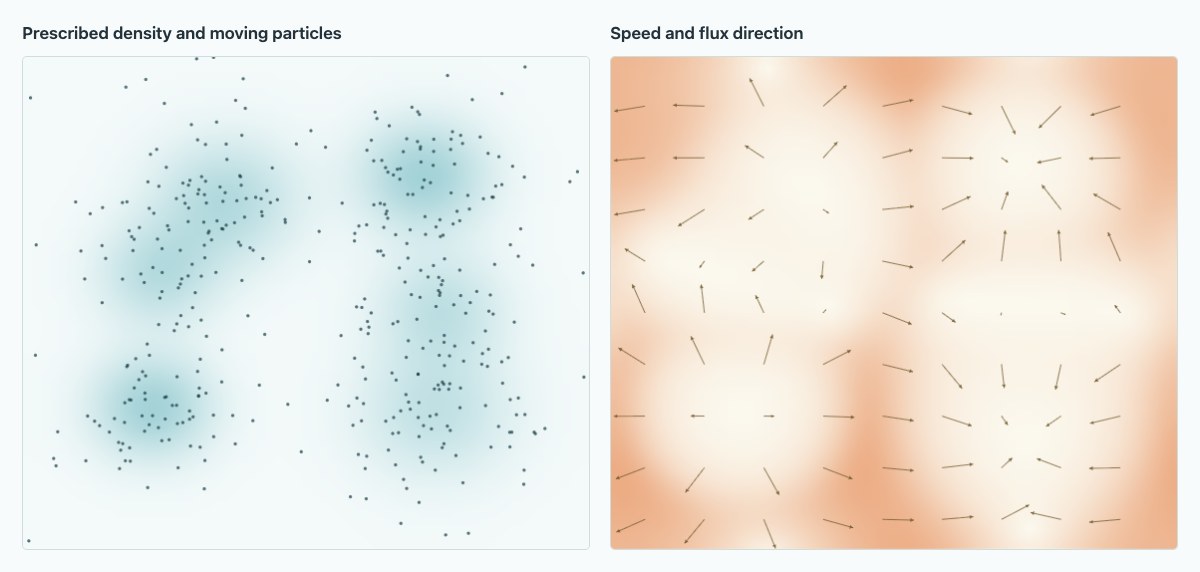
Interpolating measures by a Lagrangian flow
Prescribe the density path, solve one Poisson equation, and follow particles through a Dacorogna–Moser transport.
 Incompressibility & Fourier analysis
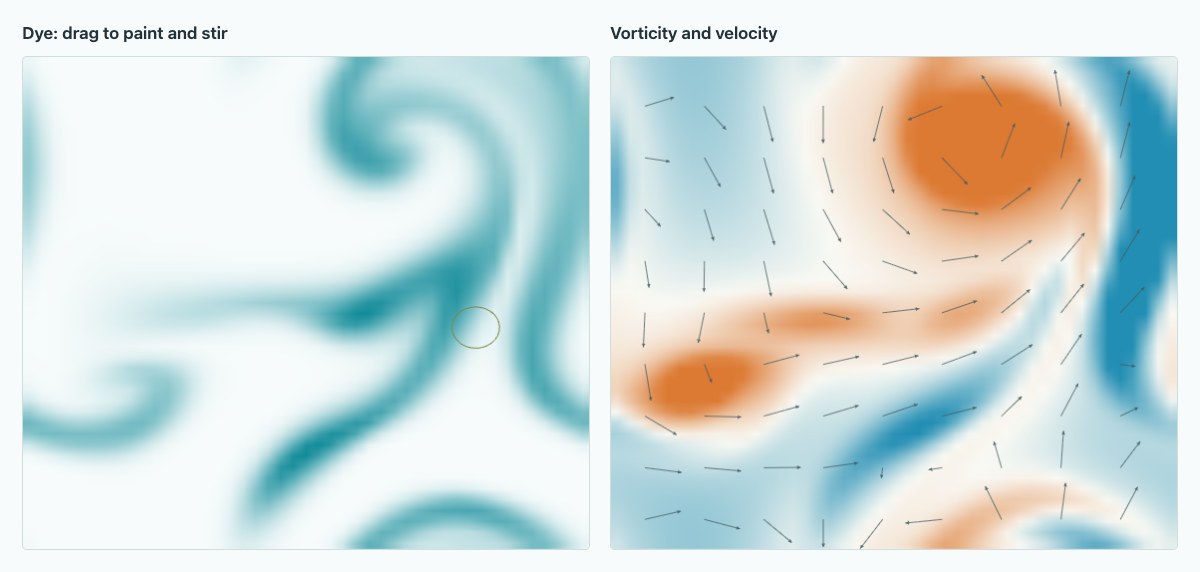
Stable fluids
Backtrace, diffuse, and project: stir a periodic fluid while inspecting divergence and dye-mass errors.
 Moment closure
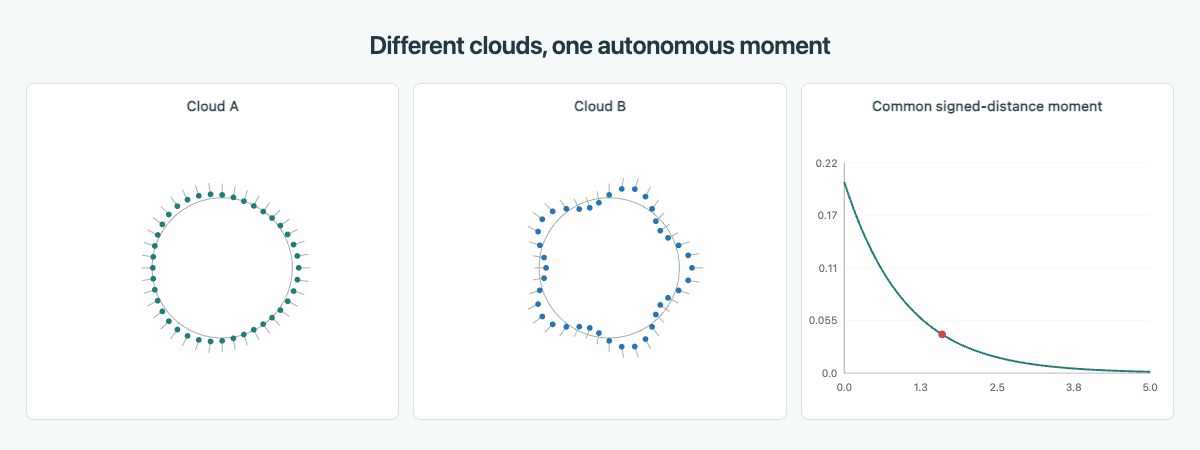
Autonomous Wasserstein statistics
When does one observable obey a closed scalar ODE? An affine squared-gradient identity gives the exact answer.
 Displacement convexity
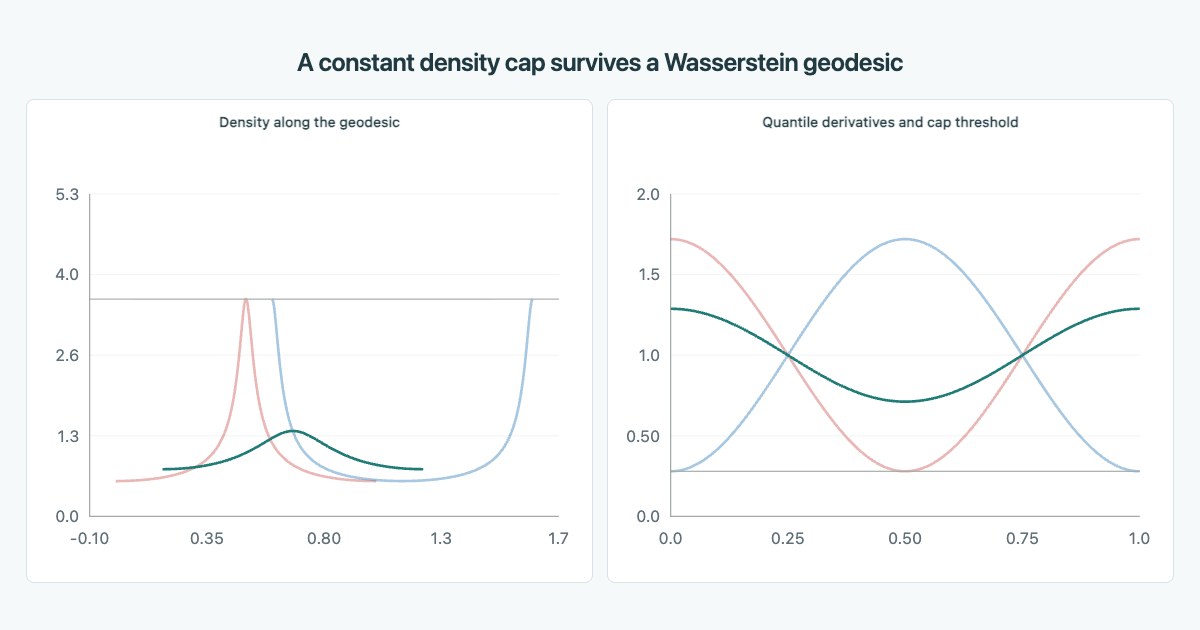
Geodesics and density caps
Transport straight lines preserve a constant upper density bound, explaining when a hard congestion constraint is inactive.
Probability and sampling
 Nonreversible sampling
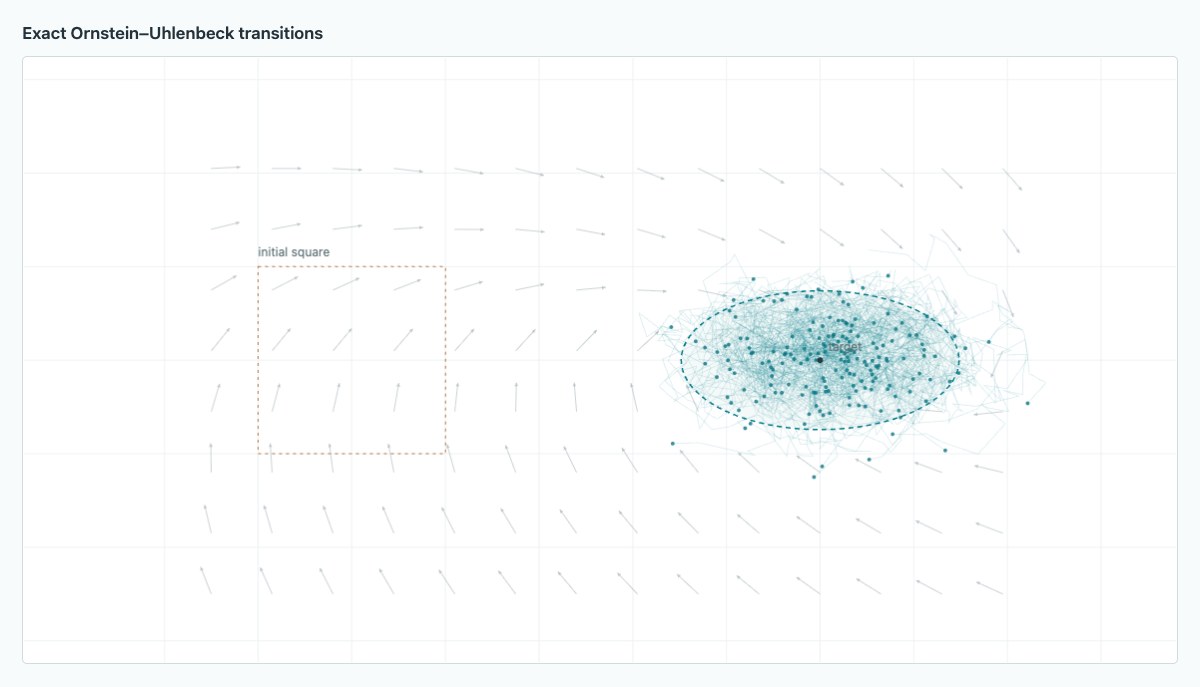
Langevin without a potential
Confinement gives an invariant law; gradient structure identifies it. An exact Gaussian experiment reveals stationary circulation.
Classical & quantum informationFrom Classical to Quantum Pinsker Inequality
A classical two-outcome argument leads to a self-contained matrix proof with the same sharp entropy constant.
 Central limit theorem
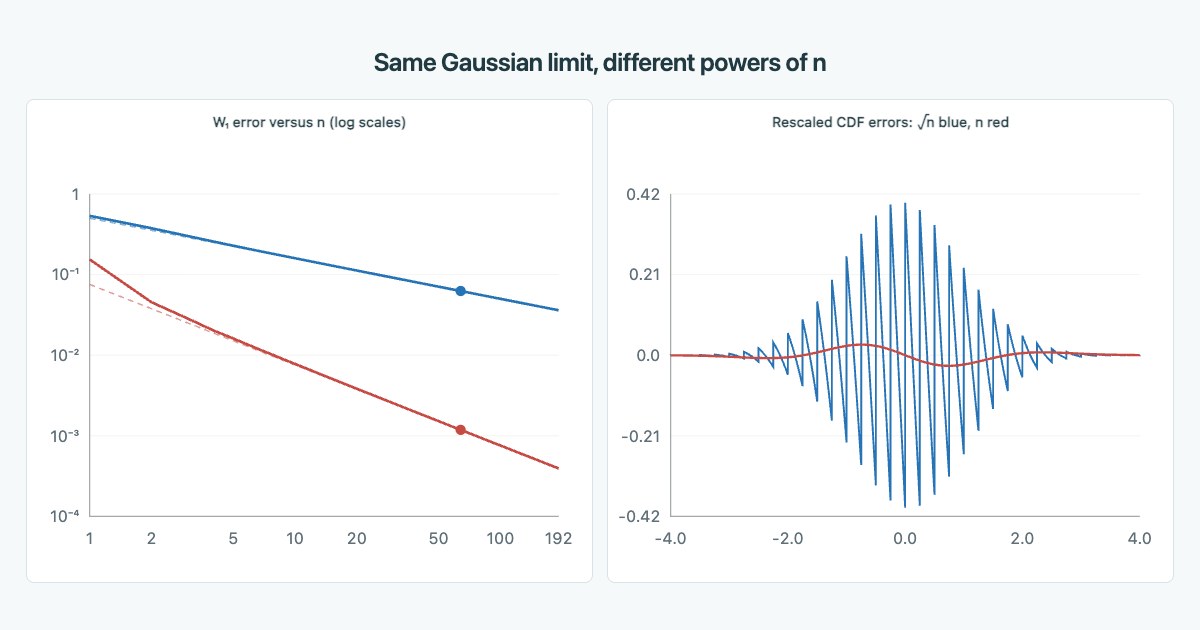
One Gaussian limit, two rates
Symmetry removes skewness but cannot remove a lattice: Bernoulli and uniform sums have different Wasserstein asymptotics.
 Quantization
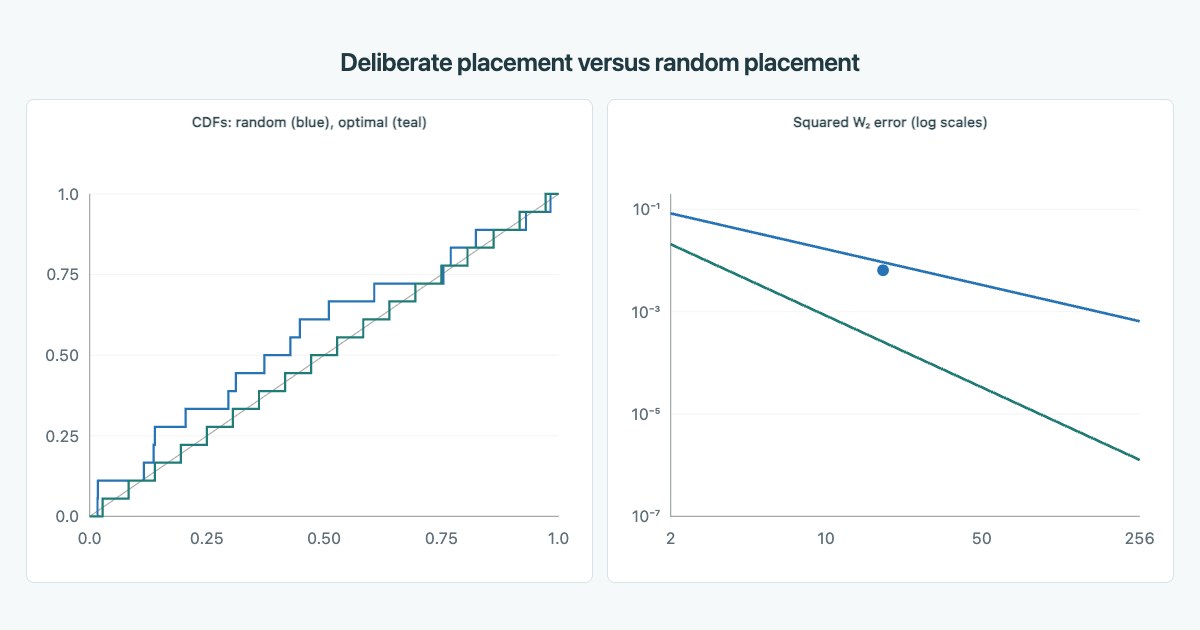
Carefully placed versus random particles
Quantile-bin averages give the best equal-weight particles, with an exact comparison to random sampling on an interval.
Information geometryTwo geometries of divergence
Density ratios and convex tangent gaps define different families. Their overlap singles out relative entropy.
Functions of measures
The perspective transform: convexity on measures
One mass-weighted Jensen inequality connects Csiszár divergences, the Benamou–Brenier action, and transport with creation and destruction.
 Constructive approximation
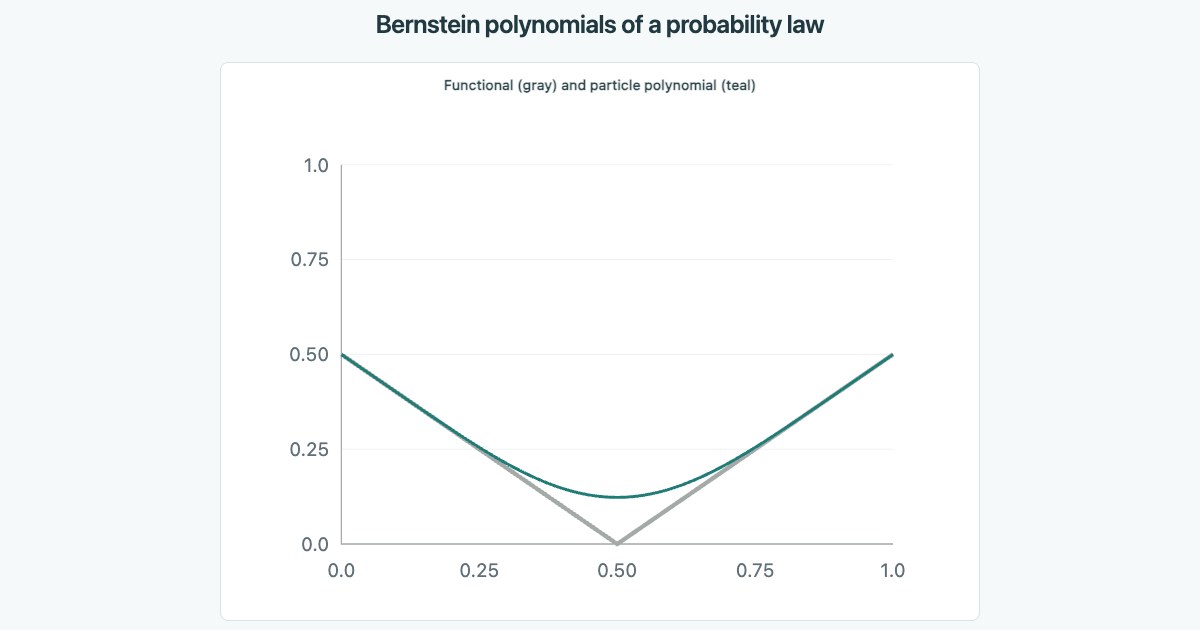
Bernstein polynomials on measures
Sample, evaluate, average: an explicit polynomial approximation with a uniform convergence proof and dimension-dependent rates.
Transformers & transportIn-context composition
Move the query and its context together: a lifted composition rule connecting transformer layers, particle dynamics, and the continuity equation.
Functions of measuresUniversality of Wasserstein polynomials
Stone–Weierstrass on probability measures, interaction features, and the passage from point clouds to operators.
Optimization and approximation
Universality and invariance
Separate what a network can distinguish from what it can approximate: 1-WL for graphs, feature concatenation, and a relative Stone–Weierstrass theorem.
 Gaussians & harmonic analysis
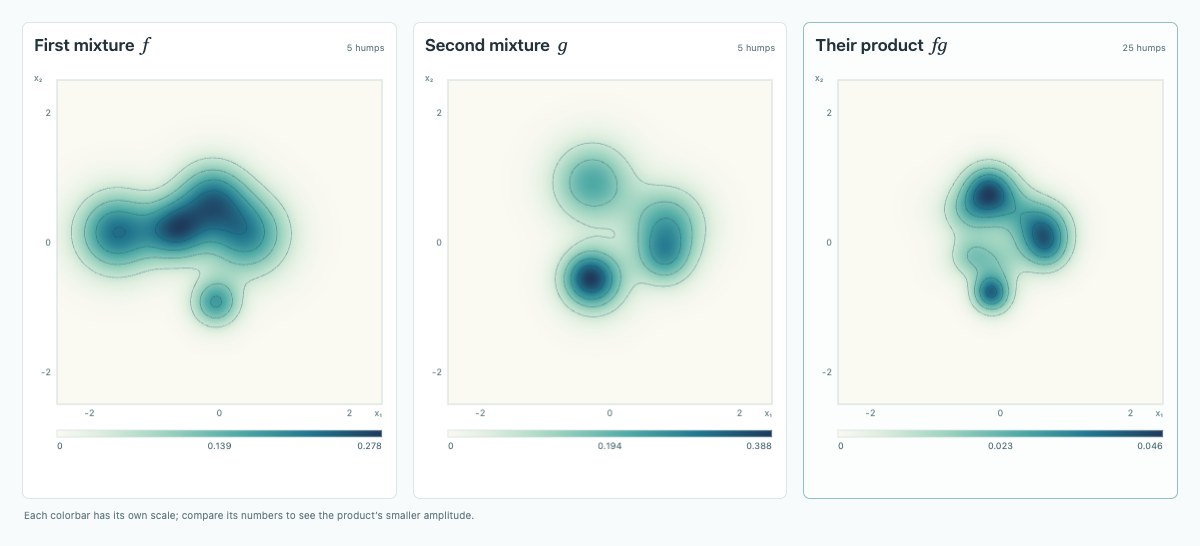
The hump algebra of Yves Meyer
Gaussian products, an atomic Banach-algebra norm, and a Besov description of multiscale regularity, with moving two-dimensional mixtures.
Neural networks & symmetryFrom MLP universality to ConvNet Universality
Exponential features prove shallow universality; weight sharing gives an equivariant ConvNet, and an accumulator trades width for depth.
 Projection algorithms
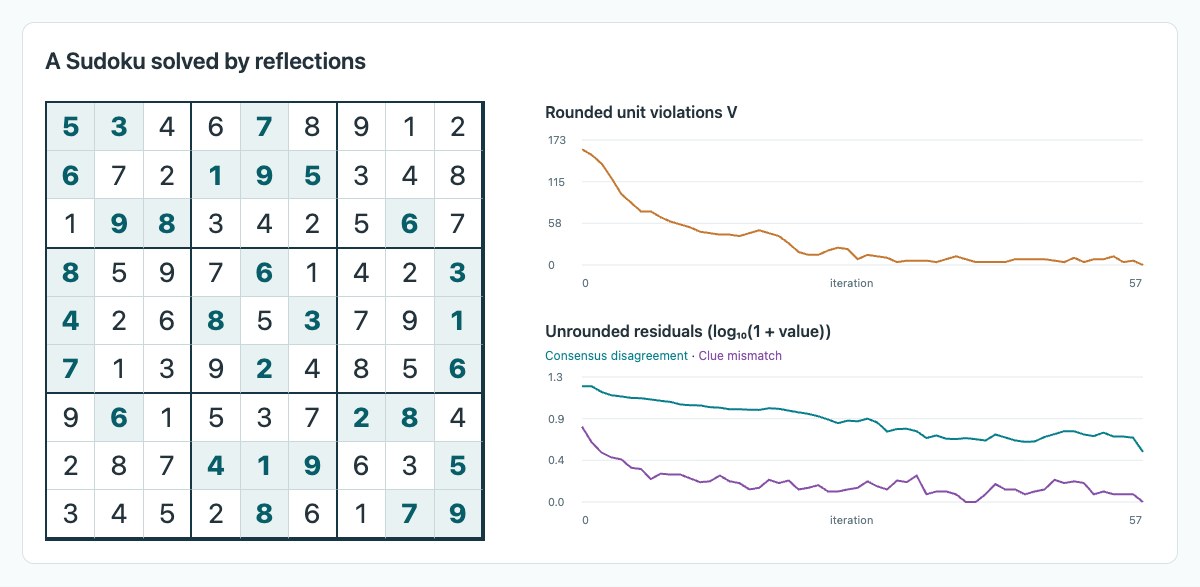
Iterative projections: Dykstra and Douglas–Rachford
Separate feasibility from nearest-point projection, then explore a genuine Douglas–Rachford Sudoku solver.
 Implicit geometry
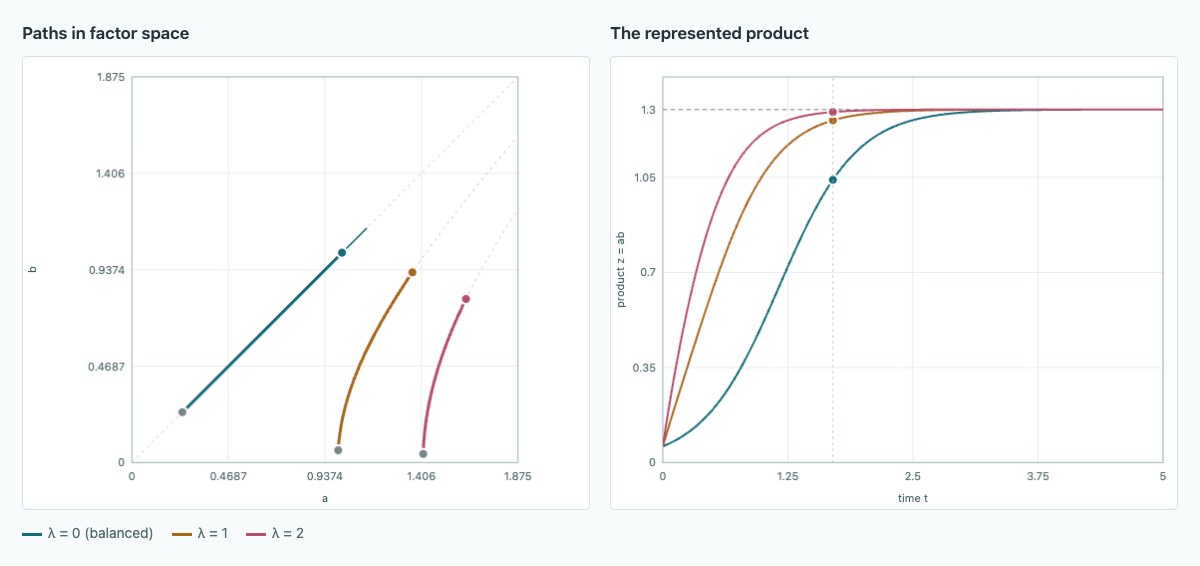
Intrinsic dynamics of overparameterized dynamics
A conserved imbalance can close the dynamics of the represented matrix, with scalar hyperbolas and symmetric square roots.
 Low-rank optimization
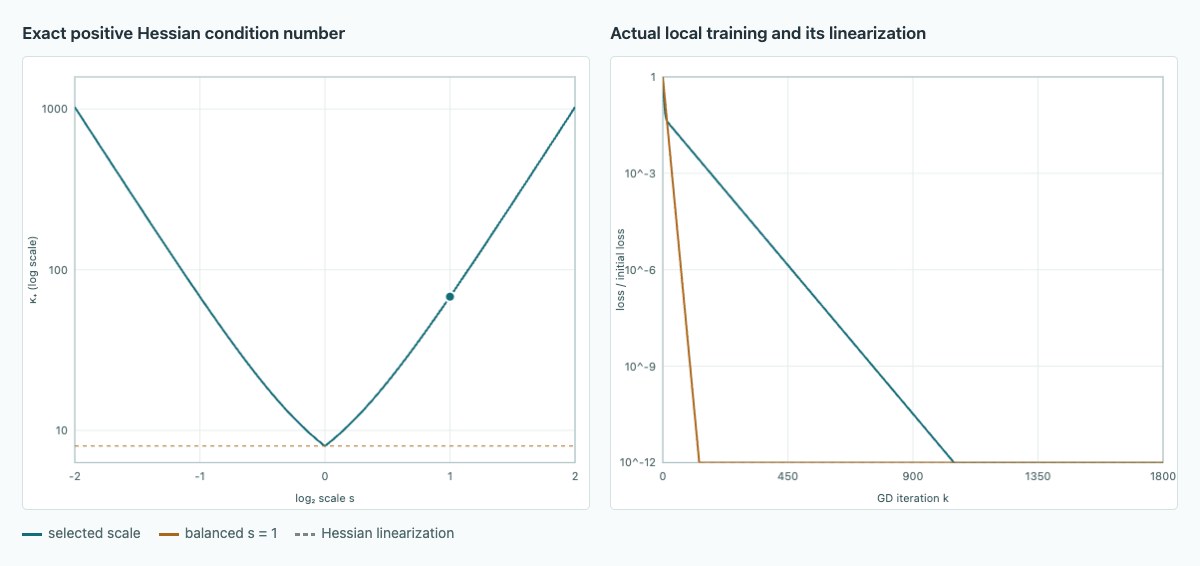
Optimal conditioning of low-rank adaptation
The same product can have very different Hessian conditioning. Balancing removes avoidable slow directions.
 Norm-steepest descent
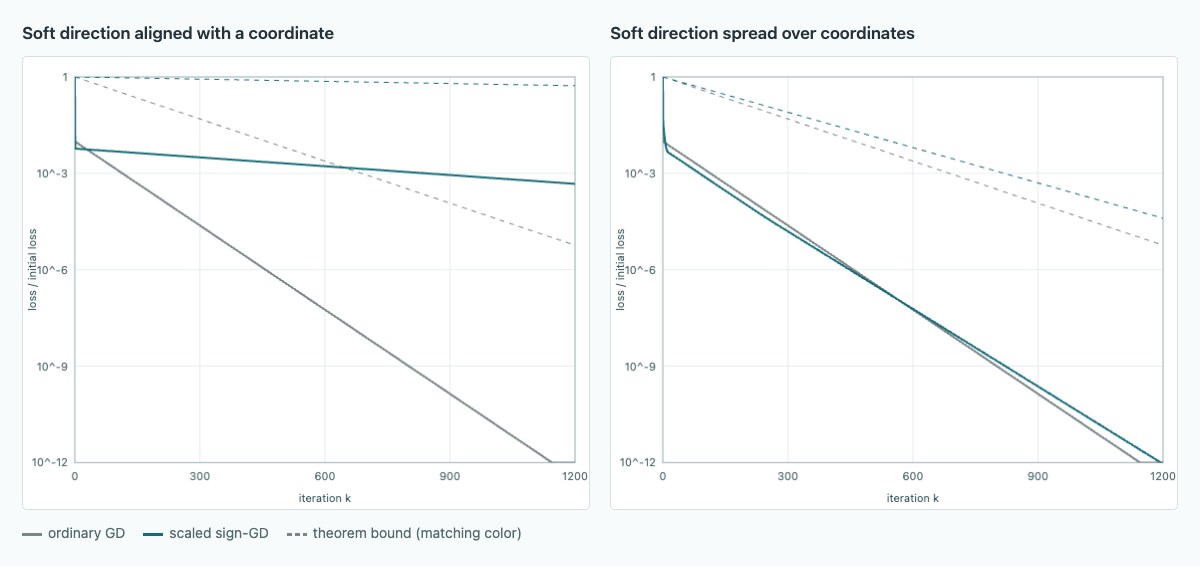
Conditioning of Non-Euclidean Gradient Descent
Two quadratics share their eigenvalues but not their coordinate geometry. Compare scaled sign descent with ordinary gradient descent.
Tensor geometryWhen the best low-rank tensor approximation does not exist
Two diverging rank-one terms approach a tensor needing three: an elementary proof of the border-rank obstruction.
 Stochastic optimization
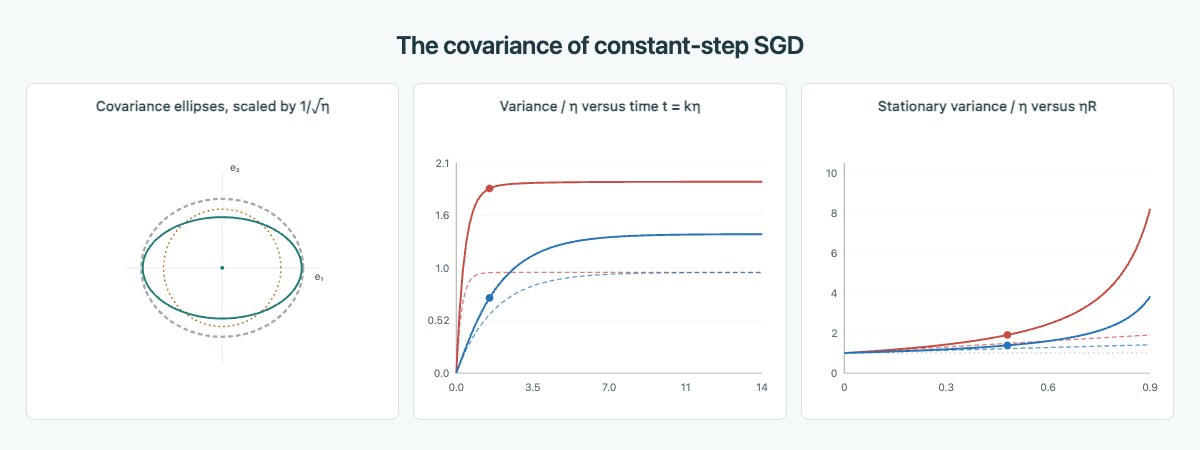
The covariance of SGD iterates
An exact least-squares recursion explains an isotropic noise floor, anisotropic relaxation, and the fourth-moment correction at finite step size.
Convex relaxationAn Axiomatic Definition of the Wasserstein Distance
Start with costs between points. Kantorovich transport is their largest convex, lower-semicontinuous extension to distributions.
Convex dualityDC programming and Toland duality
A short duality proof, the DC algorithm, and how a convex dual can reveal global solutions of a nonconvex problem.