This chapter focuses on algorithmic convergence for entropic optimal
transport: the marginals and the temperature are fixed, and one asks how
Sinkhorn iterates, soft transforms and related monotone scaling procedures
approach their regularized fixed point. Statistical convergence is a separate
question, because the empirical marginals then change with the sample size;
this is the topic of Paragraph.
The chapter revisits Sinkhorn convergence through several complementary
lenses. Bregman projections explain the alternating-projection geometry,
while Fortet’s order argument gives qualitative fixed-point convergence.
Robust Bregman estimates then give a non-asymptotic O(1/ℓ) dual-gap bound,
and Hilbert’s metric gives a global linear contraction when the kernel is
uniformly positive. A local spectral analysis sharpens this factor and
motivates over-relaxation and variable projection. The last sections discuss
Gaussian closed forms and continuous ε-Sinkhorn flows as model
cases where the fixed-point structure becomes explicit.
from pathlib import Path
import sys

from IPython.display import Image as DisplayImage
from IPython.display import display

here = Path.cwd()
myst_dir = None
for candidate in [here, here.parent, here / "myst", here.parent / "myst", here.parent.parent / "myst"]:
    if (candidate / "ot4ml_web.py").exists():
        myst_dir = candidate.resolve()
        sys.path.insert(0, str(myst_dir))
        break

if myst_dir is None:
    raise RuntimeError("Could not locate myst/ot4ml_web.py")

repo_root = myst_dir.parent
thumbnails = repo_root / "notebooks-figures" / "thumbnails"

def show_book_figure(name, width=760):
    display(DisplayImage(filename=str(thumbnails / f"{name}.png"), width=width))
Sinkhorn can be read as alternating Bregman projections. The main geometric
message is simple: each row or column rescaling is the KL projection onto one
affine marginal constraint. The convergence mechanism then follows from the
Pythagorean identity for Bregman divergences.
For simplicity, this section is written for discrete measures. The same ideas
carry over to general measures, and the robust-rate section below expresses
the constants through cost and potential oscillations rather than through the
number of grid points.
The projection viewpoint explains Sinkhorn as repeated enforcement of one
marginal constraint at a time. It is not specific to entropy, although KL is
the case where the projections reduce to elementary row and column scalings.
For the quadratic generator
Φ(P)=21∥P∥F2 on
Rn×m, one recovers half the squared Euclidean distance,
BΦ(P∣Q)=21∥P−Q∥F2. For the negative entropy
Φ(P)=∑i,jPi,jlogPi,j on the nonnegative orthant,
extended by +∞ outside it, one obtains
BΦ(P∣Q)=KL(P∣Q). For P≥0 and Q>0,
this identity is understood through the lower-semicontinuous extension, with
0log0=0.
Bregman divergences are useful because their geometry can encode constraints.
A Legendre-type generator blows up, or has an infinite derivative, at the
boundary of its domain. For negative entropy, positivity is therefore built
into the divergence, so one projects onto affine marginal constraints without
separately handling non-negativity.
Adding a linear cost to a Bregman penalty merely shifts the reference point in
dual coordinates. The usual Gibbs--KL reformulation is exactly the entropy
specialization.
On the transport polytope, scaling Ka,bϵ is equivalent to scaling
the Gibbs kernel K=e−C/ϵ because the factors ai and bj can
be absorbed into the Sinkhorn scalings. The unique entropic optimizer is the
KL projection of this tilted Gibbs reference onto the coupling constraints:
Given two closed convex constraint sets C1 and C2, the
cyclic method projects first onto C1, then onto C2, and
repeats. Full iterates satisfy the second constraint and half-iterates satisfy
the first; both are attained together only in the limit.
The following algorithm records the general cyclic iteration. The two
nonnegative constraint defects vanish on their respective sets and provide a
practical stopping test.
The convergence mechanism is the classical one of Bregman projections
Bregman, 1967. General convex constraints determine a
feasible limit, while affine constraints give the stronger closest-point
characterization.
Proof
For three interior points, the Bregman three-point formula is
Let Z(2ℓ)=P(ℓ) and
Z(2ℓ+1)=P(ℓ+1/2). For every
Q∈C1∩C2, applying this inequality at each half-step
shows that BΦ(Q∣Z(r)) decreases and that
∑rBΦ(Z(r+1)∣Z(r))<+∞. Compactness and strict
convexity imply ∥Z(r+1)−Z(r)∥→0. Hence every cluster point belongs
to both closed sets. If Pˉ is one such point, then
BΦ(Pˉ∣Z(r)) decreases to zero along a subsequence and
therefore along the whole sequence. Thus Z(r)→Pˉ.
For affine sets the first-order inequality is an equality. The dual
displacements at successive half-steps lie in the two fixed normal spaces;
telescoping gives
We now apply the general Bregman-projection framework to entropic OT. The two
affine constraints impose the source and target marginals, while negative
entropy turns their cyclic projections into explicit row and column
rescalings. Denote these constraint sets by
For negative entropy, however, the Legendre generator has effective domain
Ω=R+n×m and is +∞ outside Ω. Thus
ProjCiKL already minimizes
over Ci∩Ω: the generator enforces positivity, which need
not be repeated in the projector notation. The cyclic iteration therefore
specializes to
The Lagrange multiplier equation gives
log(p/q)+λ1=0, hence p=uq with u=e−λ>0. The
constraint fixes u=s/∑iqi, which is exactly the scaling formula.
For positive histograms and a strictly positive Gibbs kernel, iterative
proportional fitting keeps the half-steps positive and converges
Ruschendorf, 1995Rüschendorf & Thomsen, 1998. Since the two marginal sets are
affine, Proposition: Convergence of Cyclic Bregman Projections, applied with
P(0)=Ka,bϵ, identifies the limit as the entropic optimizer.
the two projection steps are the usual Sinkhorn updates on the scaling
vectors. In practice one stores the vectors and multiplies by the Gibbs
kernel, often exploiting separable, sparse, low-rank or geometric structure.
The Bregman proof is geometric, but its direct finite-dimensional linear-rate
constants can degrade with dimension and with small ϵ. The robust
dual analysis below gives a dimension-free qualitative message: before any
local linear regime becomes visible, one can still guarantee an O(1/ℓ) dual
gap whose constants depend on the cost range and potential oscillation.
The simplicity of the KL construction relies on negative entropy encoding
nonnegativity through its effective domain. Suppose instead that Φ is
Legendre on the full space Rn×m. Positivity must then be
included explicitly in the marginal constraints:
Thus
U(a,b)=Ca,+1∩Cb,+2. These sets are
convex but no longer affine, and their BΦ-projectors generally have no
closed-form scaling formula. The affine clause of
Proposition: Convergence of Cyclic Bregman Projections no longer applies: ordinary cyclic projections
may converge to a feasible point without computing
ProjU(a,b)BΦ(P(0)).
For the Euclidean generator
Φ(P)=21∥P∥F2, projection onto
Ca,+1 is a rowwise simplex projection:
The column formula is analogous. These thresholds are not multiplicative
scalings, but sorting or selection computes them efficiently
Blondel et al., 2018.
To recover the closest-point projection onto the intersection, Dykstra’s
algorithm alternates the same Bregman projectors while carrying correction
variables in dual coordinates. Under the standard finite-dimensional
assumptions, it converges to
ProjCa,+1∩Cb,+2BΦ(P(0))Dykstra, 1985Censor & Reich, 1998Bauschke & Lewis, 2000. Benamou, Carlier, Cuturi,
Nenna, and Peyré developed this construction systematically for regularized
transport Benamou et al., 2015. Through Fenchel duality,
Bregman--Dykstra is block-coordinate ascent on the marginal dual potentials;
the correction variables store the dual memory absent from plain cyclic
projection Bregman et al., 1999.
For the quadratic generator and the product reference ξ=a⊗b,
for positive ai,bj. The difference is the fixed inverse product-marginal
weighting in the second quadratic norm. Both models yield positive-part
thresholding and potentially sparse plans. The section on
Other Convex Regularizers
develops their dual laws and alternating dual-maximization algorithms.
This section isolates the order structure shared by generalized Sinkhorn
updates. It first introduces the abstract language of topical maps, then
applies it to the generalized soft transforms of
Other Convex Regularizers, and finally derives a monotone
fixed-point argument valid beyond KL regularization.
For the ϕ-divergence regularized transport problem, the one-sided block
updates are expressed using the Legendre transform ϕ∗ defined in
(47). They are the generalized soft c-transforms of
(103), and their alternating dual-maximization
scheme is (106). After
choosing a consistent extremal minimizer whenever a scalar update is not
unique, one full cycle acting on the first potential is
For the KL generator, this is the usual double Sinkhorn map.
Proof
Since ϕ is extended by +∞ on (−∞,0), its Legendre
transform ϕ∗ from (47) is convex and nondecreasing. For
fixed x, let Hgx(u) denote the scalar objective in the first line of
(103). If g≤g′, then
u↦Hg′x(u)−Hgx(u) is nondecreasing because
s↦ϕ∗(s+δ)−ϕ∗(s) is nondecreasing for every
δ≥0.
Let I=argminHgx and
I′=argminHg′x. Comparing the two optimality
inequalities shows that minI′≤minI; the same argument gives
maxI′≤maxI. Finally,
Hg+sx(u)=Hgx(u+s)+s, so either extremal selection is additively
anti-homogeneous. The second one-sided transform is symmetric. Their
composition is topical, and
Proposition: Topical Maps are Variation-Nonexpansive gives the final estimate.
Topicality gives nonexpansiveness, not a strict contraction. For KL,
positivity of the Gibbs kernel supplies the stronger Hilbert-metric
contraction proved in Sinkhorn Convergence: Linear Hilbert Metric Rate; no comparable strict factor
follows from the order properties alone for a general ϕ.
The following order argument traces back to Fortet’s proof of the Schrodinger
system Fortet, 1940Essid & Pavon, 2019Léonard, 2019. It
is not based on an optimization principle: a subsolution generates an
increasing orbit, while a fixed point provides an upper barrier.
Proof
Because Aϕ is additively homogeneous, shifting a subsolution
preserves its defining inequality. Shift it below a fixed point. Topicality
then gives
The one-sided transforms inherit the modulus of continuity of the cost. If
δ(x,x′)=supy∣c(x,y)−c(x′,y)∣, then order reversal and additive
anti-homogeneity give
The orbit is therefore uniformly bounded and equicontinuous. Arzela--Ascoli
upgrades pointwise convergence to uniform convergence. The same order and
shift properties also make each one-sided transform nonexpansive in the
uniform norm, so Aϕ is continuous and the limit is a fixed
point. The supersolution argument reverses all inequalities.
The subsolution and supersolution conditions are invariant under additive
shifts, but a shift cannot turn an arbitrary initialization into either one.
The proposition therefore isolates the genuinely order-theoretic convergence
mechanism; unrestricted initialization requires an additional compactness,
ascent, or contraction argument.
The preceding projection and monotonicity arguments establish convergence but
do not provide a quantitative rate. The Hilbert-metric analysis in
Sinkhorn Convergence: Linear Hilbert Metric Rate will give geometric, or linear, convergence, the
canonical asymptotic behavior of a strictly contractive fixed-point iteration;
however, the gap between its global contraction factor and one typically
becomes exponentially small in the cost oscillation divided by ϵ.
We therefore first establish a slower O(1/ℓ) dual-gap rate whose constant
grows only as 1/ϵPeyré, 2026Altschuler et al., 2017Dvurechensky et al., 2018. This
robust dependence is crucial when Sinkhorn approximates unregularized discrete
OT: Corollary Corollary: Approximating Unregularized OT by Regularized Dual Costs chooses
ϵ=δ/log(nm), so the temperature decreases with the requested
accuracy and with the number of support points.
Proof
Write M:=∥C∥∞. If M=0, one complete cycle produces
a⊗b. We first prove the oscillation estimate. If f is the soft
transform of g, as in Definition Definition: Soft-Min and Discrete Soft c-Transform, set
Since 0≤Cij≤M, one has
e−M/ϵZi′≤Zi≤eM/ϵZi′ for every i,i′.
Hence ∣fi−fi′∣≤M and ∥f∥V≤M. The same argument applies
to the other soft transform. Every Sinkhorn potential is produced by one of
these transforms, and the block optimality equations give the same property
at an optimum. Therefore
At the end of cycle ℓ, P(ℓ):=P(f(ℓ),g(ℓ)) has
column marginal b. Let r(ℓ):=P(ℓ)1m and
δℓ:=∥∥a−r(ℓ)∥∥1. The dual gradient is then
(a−r(ℓ),0), so concavity gives
The matrices before and after this update both have total mass one. Direct
substitution in the dual objective therefore gives the exact gain
ϵKL(a∣r(ℓ)). The subsequent column update
can only increase the objective. Pinsker’s inequality, Theorem
Theorem: Pinsker Inequality, and (40) give
It remains to initialize this recursion uniformly in ϵ. Set
x=M/ϵ, and let P(1) be the matrix after the first row
update from g(0)=0. The update formula gives
Together with the initial bound, telescoping proves
Δ(ℓ)≤2M2/(ϵℓ). If a gap vanishes, all subsequent
gaps vanish and the result is immediate.
The assumption C≥0 is harmless for transport costs. For a signed matrix,
subtracting mini,jCij leaves Sinkhorn iterates and dual gaps unchanged
up to gauge; the proposition then applies to the normalized nonnegative cost.
The preceding rate becomes useful when Sinkhorn serves as an approximate solver
for exact OT. With the KL-normalized dual, the iterate itself can be compared
with the unregularized cost, without any additive entropy correction.
Proof
Let Lϵ:=maxf,gDϵ(f,g) and let P0 solve
the unregularized problem. The KL-normalized primal formulation gives
The last inequality follows from
KL(P0∣a⊗b)=H(a)+H(b)−H(P0)≤log(nm).
Proposition Proposition: Robust O(1/ℓ) Dual Rate for Discrete Sinkhorn gives
0≤Lϵ−Dϵ(f(ℓ),g(ℓ))≤2∥C∥∞2/(ϵℓ). The computed error is the difference
of these two nonnegative quantities, so its absolute value is bounded by their
maximum. Both are at most δ under the stated choices.
For a dense n×n problem, one Sinkhorn cycle costs O(n2) operations.
The corollary therefore gives
arithmetic complexity for additive accuracy δ. At fixed accuracy and
normalized cost scale, this is nearly quadratic in n, compared with the
exact O(n3) Hungarian method of Proposition
Proposition: Correctness and Complexity of the Hungarian Primal-Dual Method and the O(n3) work per scaling phase of
auction in Proposition Proposition: Complexity of ε-Scaling. The accuracy
comparison is reversed: Sinkhorn’s present guarantee is
polynomial in 1/δ, whereas Hungarian is exact, scaled auction is exact
for integer costs once its tolerance is below 1/n, and self-concordant
interior-point analysis in Section Linear-Programming Algorithms has
logarithmic dependence on 1/δ but requires costly Newton solves. These
assignment comparisons concern uniform square
problems. They show why Sinkhorn is especially effective for large-scale
problems requiring low or moderate precision rather than highly accurate exact
solutions.
Hilbert’s projective metric measures positive scaling vectors modulo global
multiplication. A positive kernel contracts this geometry, yielding a global
linear rate for Sinkhorn scaling rays.
Multiplying either vector by a positive scalar leaves H unchanged,
so it is a metric on projective classes.
Proof
The logarithm identifies the projective cone with
Rn/span(1n). The variation seminorm vanishes
exactly on constants and induces a norm on this finite-dimensional quotient.
Proof
Set F(z)=log(Kez). Its Jacobian is the row-stochastic matrix
For a row-stochastic matrix P, the Dobrushin estimate gives
∥Ph∥V≤δ(P)∥h∥V, with
δ(P)=21maxi,j∑k∣Pi,k−Pj,k∣. For two rows p,q,
let a=minkpk/qk, b=maxkpk/qk. Since
a≤1≤b and b/a≤η(K), splitting where pk≥qk and
optimizing under these bounds gives
Thus ∥DF(z)h∥V≤λ(K)∥h∥V. Integrating the derivative of
F(z+t(z′−z)) from 0 to 1 proves the claim because
H(ez,ez′)=∥z−z′∥V.
Before applying this to nonlinear Sinkhorn scaling, consider ordinary power
iteration. For a positive square kernel K, normalize Ku on any fixed
positive affine section of the projective cone. The preceding contraction
theorem and completeness of this cone give a unique fixed ray u⋆>0,
hence the Perron--Frobenius eigenvector up to scale, and
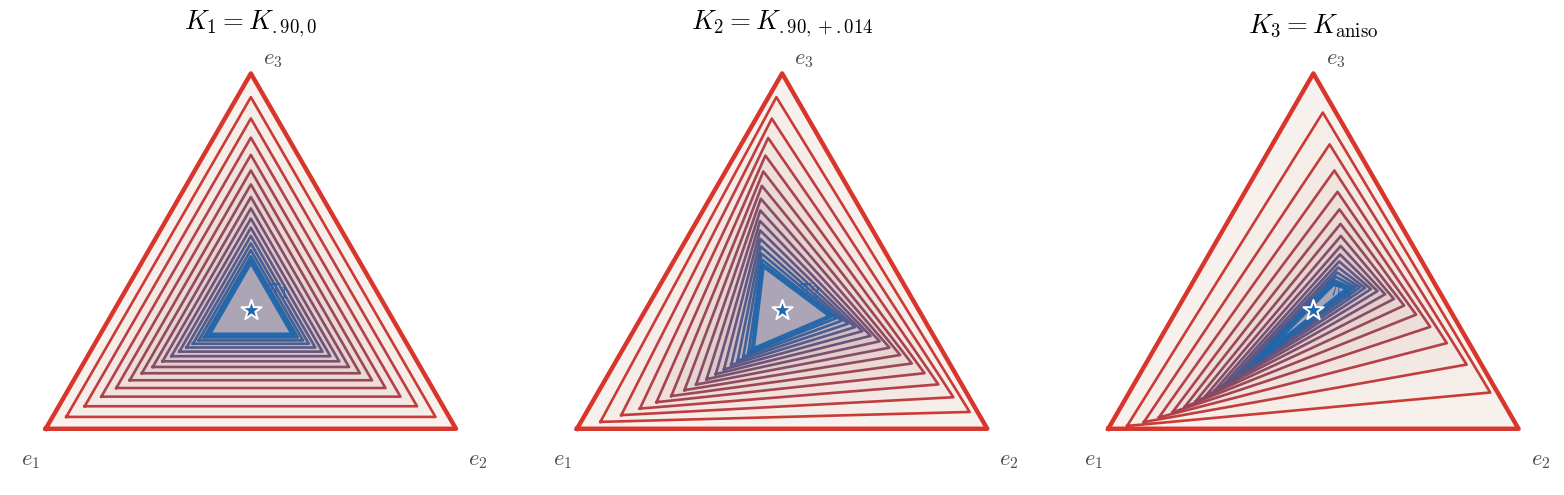
Figure Div displays this
contraction simultaneously for the entire three-state simplex. It uses
J3=1313⊤/3 and
Kρ,δ=ρI3+(1−ρ)J3+δA, where A is skew-cyclic,
together with a positive non-normal kernel. These choices respectively show
isotropic contraction, contraction with rotation, and anisotropic contraction.
Positive Markov kernels contract the three-state simplex and can
simultaneously rotate its image. Color progresses from red at the initial
simplex to blue near the Perron eigenvector, marked by a star. The panels show
an isotropic baseline, a rotating kernel, and an anisotropic non-normal kernel.
A Sinkhorn cycle composes two positive kernel maps with entrywise inversion and
multiplication. The kernel maps contract Hilbert distance, whereas the latter
two operations are projective isometries. A complete row--column cycle thus
contracts by the square of the kernel factor. The following theorem, due to
Franklin and Lorenz Franklin & Lorenz, 1989, makes this argument precise.
Proof
The row map R(v)=a/(Kv) and column map C(u)=b/(K⊤u) are each
λ-Lipschitz because inversion and multiplication are Hilbert
isometries. The full cycles C∘R and R∘C therefore contract by
λ2. For a q-contraction F,
d(x,x⋆)≤d(x,Fx)/(1−q), which gives the posterior estimates from the
marginal violations. Finally,
log(Pi,j(ℓ)/Pi,j⋆)=ξi+ζj. Equal total masses imply
that zero lies between the minimum and maximum of ξ⊕ζ, so its
supremum norm is bounded by its oscillation.
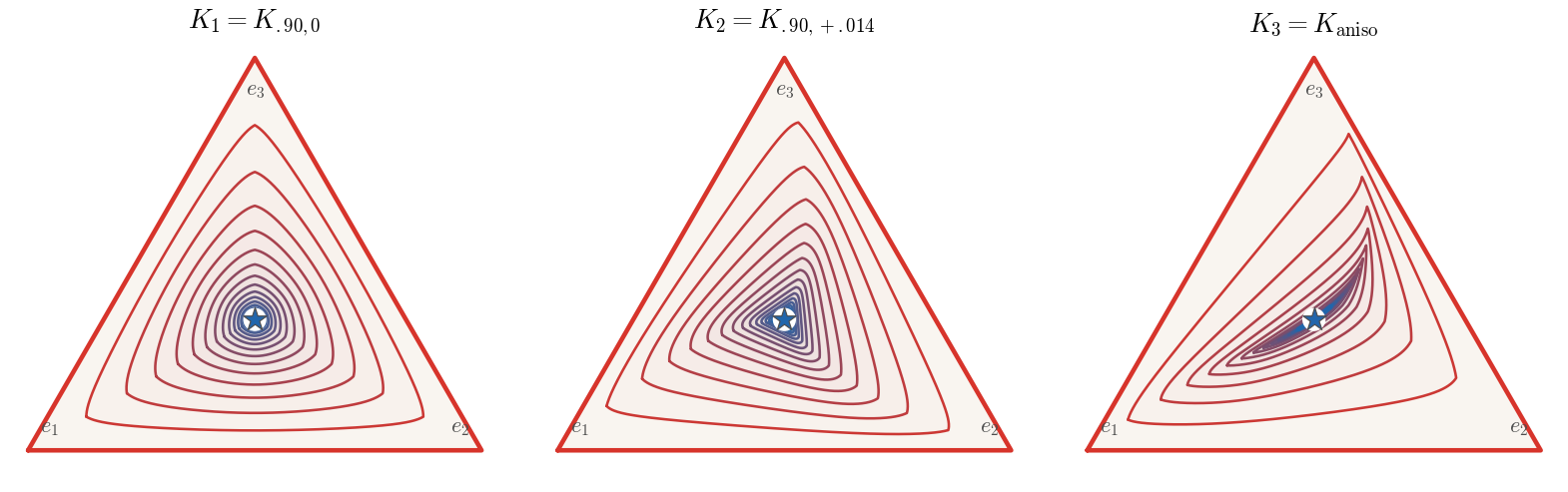
The projective contraction can be visualized simultaneously for every possible
left-scaling ray. Using the row and column maps from the proof, define the
full-cycle map
The figure reuses the three kernels Ki from
Div, with the same uniform
Sinkhorn marginals a=b=13/3 in every panel. This isolates the passage from the linear action
Kiℓ to the nonlinear balancing map Fu,iℓ. The
symmetric control remains aligned, K2 turns the curved images, and the
unequal tangent rates of K3 produce a pronounced anisotropic collapse. The normalized
Sinkhorn fixed ray and stationary Markov vector both equal 13/3 in
this doubly stochastic example, although they need not coincide in general.
Figure Div reuses the three kernels Ki from Figure Div, with the same uniform Sinkhorn marginals a=b=13/3 in every panel.
# The same three kernels under complete Sinkhorn cycles.
show_book_figure("sinkhorn-projective-scaling-simplex")
Complete Sinkhorn cycles curve, turn and contract the simplex of normalized
left scalings. Panel i reuses Ki from the preceding linear figure and
the common marginals a=b=13/3. Color is the densely sampled boundary
of Fu,iℓ(Δ3), progressing from the red triangle
at ℓ=0 to the blue curve at ℓ=15; the star is
ui⋆=13/3. Reciprocal scaling bends all sixteen
boundaries; K2 adds a gradual turn, whereas the non-normal K3 combines
turning with a much stronger collapse across one tangent direction.
For these invertible kernels the curves are the actual boundaries of the
nested image sets. The Hilbert estimate begins after the first positive cycle.
Thus the global rate becomes exponentially pessimistic as
ϵ↓0. Sharper continuous analyses obtain polynomial rates
under additional semiconcavity or log-concavity assumptions
Chizat et al., 2026. In practice, monitor the marginal not just
normalized: the source residual at P(ℓ) and the target residual at
P(ℓ+1/2) are the two meaningful posterior diagnostics.
The global projective rate of Sinkhorn Convergence: Linear Hilbert Metric Rate depends only on the
kernel and can be pessimistic near the solution. Linearization reveals a
sharper common structure: the dual Hessian, the Jacobian of a complete
Sinkhorn cycle, and the curvature of the entropic semi-dual are governed by
the same conditional-expectation operator. This gives the exact local factor
and motivates blockwise over-relaxation and variable projection.
Let
L02(α)={h∈L2(α):∫hdα=0} and define
L02(β) similarly.
The two operators are adjoint in the marginal L2 spaces. Conditional
Jensen gives ∥Tπ∥≤1, and constants are preserved, so
0≤σ(π)≤1. In the discrete setting,
with adjointness in the weighted Euclidean inner products. Thus
σϵ is the largest nonconstant singular value of the normalized
optimal coupling, equivalently the second singular value of
diag(a)−1/2Pϵdiag(b)−1/2.
The next result linearizes the dual objective and the two soft transforms at
the same optimum.
Proof
Twice differentiating the exponential term in the entropic dual and using the
optimal density law gives (68). The marginal
terms form the two identity blocks and the cross term is represented by
Tϵ, which gives (69). On centered
functions, the cross term is bounded in absolute value by
σϵ∥h∥∥k∥; the common-constant direction has eigenvalue
2/ϵ, while (1,−1) is the gauge kernel. This proves the spectral
bounds. Differentiating either log-partition formula gives minus the
corresponding conditional expectation, proving
(70). The chain rule then yields
(71) because
∥Tϵ∗Tϵ∥L02(β)=σϵ2.
The law of total variance gives the useful gap formula
Sinkhorn therefore slows down when the conditional laws Y∣X=x become
nearly deterministic, as happens when ϵ→0 in a smooth Monge regime.
As expected, a global contraction factor must bound the derivative of the
iteration at its fixed point. The next proposition makes this comparison
precise, while emphasizing that the kernel-only global estimate can be much
more pessimistic than the coupling-dependent local rate.
Proof
The row and column scaling maps are each λ(K)-Lipschitz in Hilbert’s
metric, so a complete cycle is λ(K)2-Lipschitz. Under
g=ϵlogv, this is the variation norm on potentials. Differentiating
at the fixed point gives
∥Tϵ∗Tϵh∥V≤λ(K)2∥h∥V.
Applying this to a leading centered eigenvector of the positive self-adjoint
operator Tϵ∗Tϵ yields the claim.
The global inequality is robust but often pessimistic. In a smooth
nondegenerate Monge regime, the conditional laws have width
O(ϵ); a coercive Laplace expansion then suggests
1−σϵ2≍ϵ, whereas the kernel-only Hilbert factor can
approach one exponentially fast.
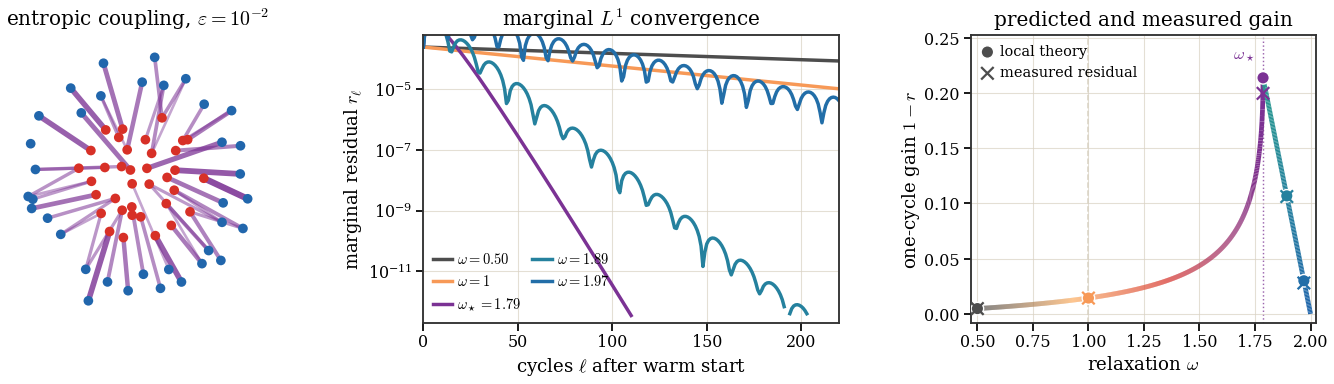
Its characteristic polynomial is
z2−(2(1−ω)+ω2s2)z+(1−ω)2. The worst mode is
s=σϵ. Its roots have equal modulus when
ω2σϵ2=4(ω−1); the smaller solution is
ω⋆, and the common modulus is ω⋆−1. The dominant
modulus decreases before this value and increases after it.
Writing δϵ=1−σϵ2, the accelerated factor obeys
r⋆=1−2δϵ+2δϵ+O(δϵ3/2), compared with
1−δϵ for ordinary Sinkhorn.
show_book_figure("sinkhorn-overrelaxation")
Blockwise over-relaxation accelerates local Sinkhorn convergence. Left: the
small-temperature entropic coupling. Middle: marginal residuals after a common
ordinary-Sinkhorn warm start for five relaxation parameters. Right: the
continuous curve is the theoretical local gain 1−rloc(ω);
filled circles mark the five displayed parameters and crosses are empirical
gains fitted from the marginal residuals. The palette switches to teal--blue
beyond ω⋆ to distinguish the post-optimal branch.
This is variable projection (VarPro): one optimizes out a block whenever its
conditional optimizer is available. Its Schur-complement Hessian cannot worsen
local conditioning Golub & Pereyra, 1973Golub & Pereyra, 2003.
VarPro was introduced for separable nonlinear least-squares problems. A
representative example is training a two-layer network through
using the weights (U,V) and activation σ of the models studied in
Section Training Two-Layer MLPs as Wasserstein Flows. For fixed V, the outer weights U
are obtained by linear least squares before optimizing the reduced, generally
nonconvex objective in VKim & Lee, 2008. In entropic OT,
(U,V) is replaced by the potential pair (f,g), the objective
Dϵ(f,g) is jointly concave, and the eliminated block has the
closed-form maximizer f=gcˉ,ϵ.
Proof
The envelope theorem gives the first derivative. Differentiating the normalized
conditional Gibbs law gives the covariance formula. At the optimum, total
covariance yields I−Tϵ∗Tϵ, and the spectral bounds follow
from the definition of σϵ.
For a generic VarPro problem, the Schur-complement improvement is only
qualitative because the full and reduced spectra depend on several unrelated
Hessian blocks. Here both diagonal blocks in
(69) are identities, while the off-diagonal
blocks are Tϵ and Tϵ∗. Both condition numbers therefore
depend only on σϵ: the full-dual bound is
2/(1−σϵ), whereas the semi-dual bound is
1/(1−σϵ2). Eliminating f thus improves the bound by the
explicit factor 2(1+σϵ).
Gaussian marginals provide an explicit finite-dimensional model of Sinkhorn’s
behavior. The soft c-transform preserves quadratic potentials, the optimal
entropic coupling is Gaussian, and the value can be written with matrix square
roots Janati et al., 2020. This is the entropic counterpart of the
Gaussian W2 and Bures formula.
Gaussian log densities and soft transforms are quadratic, so every dual
Sinkhorn iterate is a quadratic polynomial and the algorithm closes on
finitely many coefficients.
Proof
The exponent is the sum of a quadratic polynomial in y and the logarithm of
the Gaussian density of β. Completing the square in y evaluates the
integral as a positive constant times the exponential of a quadratic
polynomial in x. Taking −ϵlog therefore gives a quadratic
polynomial.
Closure of the iterates suggests, but does not by itself prove, Gaussian
optimality. Entropy maximization at fixed covariance supplies the variational
argument and yields the following closed form.
Proof Sketch
For any coupling, replace (X,Y) by the Gaussian vector with the same mean
and covariance. The quadratic cost is unchanged, and Gaussian laws maximize
entropy at fixed covariance, so the relative entropy cannot increase. It is
therefore enough to optimize over Gaussian couplings.
Writing the cross-covariance as
K=Σα1/2SΣβ1/2, the block covariance constraint
is equivalent to the singular values of S being at most one. The cost
depends on K through −2tr(K), while
The first-order condition is
2σi=ϵs/(1−s2), whose positive solution is the displayed
si.
Debiasing the preceding closed form cancels the separate trace terms and
produces a smooth spectral approximation of the Bures covariance term.
Proof Sketch
The raw Gaussian entropic value is the squared mean displacement plus two
trace terms and the spectral sum
∑iψϵ(σi(Σα,Σβ)). Applying the
same formula to the self-costs (α,α) and (β,β) replaces
the cross singular values by the eigenvalues of Σα and
Σβ.
In the debiased polarization formula, the trace terms cancel:
The polarization of the squared mean terms leaves
∥mα−mβ∥2. Finally,
τϵ(r)→1 and
ϵlog(1−τϵ(r)2)→0, so
ψϵ(r)→−2r. The covariance limit is therefore
which is the Bures--Wasserstein covariance formula.
The controls below expose exactly the quantities in the formula: ϵ
sets the singular-value shrinkage, anisotropy changes the eigenvalues, and the
angle changes the covariance misalignment.
Interactive panel. This exploratory panel exposes the Gaussian formula directly. Use epsilon, anisotropy, and angle to see how entropic shrinkage changes the covariance term.
The one-dimensional isotropic case permits an exact non-asymptotic analysis
along the invariant family of quadratic potentials.
which proves the exact identity by iteration. Moreover, A0>A⋆ and the
iterates stay in [A⋆,A0]. On this interval,
0<M′(A)≤A⋆−4, so
0≤Aℓ−A⋆≤A⋆−4ℓ(A0−A⋆). Since
A0−A⋆=q⋆ and
Aℓ−A⋆=q⋆−q(ℓ), this is the announced bound.
Since A⋆−4=1−ϵ+O(ϵ2), reducing the relative error
(q⋆−q(ℓ))/q⋆ below δ requires only
O(ϵ−1log(1/δ)) cycles. This is much less pessimistic than
the global Hilbert estimate: it is unavailable on the full Gaussian space
because the quadratic cost is unbounded, and on a bounded truncation its gap
from one is exponentially small in 1/ϵ. There is no contradiction,
because the explicit bound applies only to the invariant quadratic family
Chizat et al., 2026.
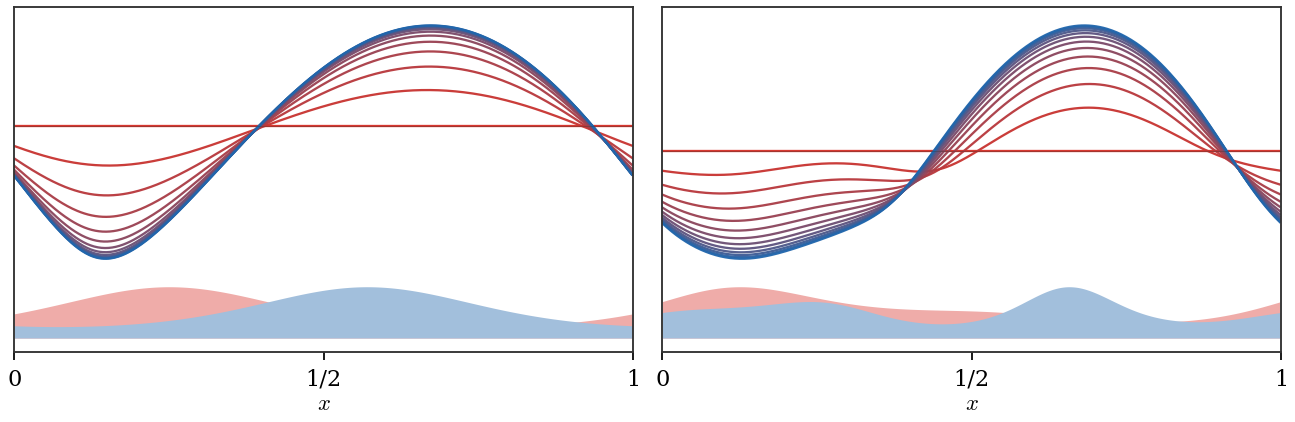
A complementary limit sends the entropic temperature to zero while increasing
the number of Sinkhorn cycles proportionally to 1/ϵ. After assigning
time step ϵ to one complete cycle, the discrete fixed-point iteration
converges formally to a parabolic Monge--Ampere equation for the transport
potential.
Work on the flat torus Td with quadratic periodic cost and smooth
positive densities dα=e−Fdx, dβ=e−Gdy.
Proof
Stationarity says that
logdet(I+∇2u)−G(T)+F is constant. Integrating the associated
change-of-variables identity fixes this constant to zero, giving
e−F(x)=e−G(T(x))detDT(x), which is exactly T♯α=β.
The equilibrium a⋆=σβ/σα,
q⋆=mβ is the one-dimensional Gaussian Brenier map. No equation is
needed for the additive constant because the gauge removes it.
Continuous ϵ-Sinkhorn flow in one dimension. The curves are
snapshots of the gauge-fixed potential ut, initialized at u0=0, under
the parabolic Monge--Ampere equation. Time runs from red to blue; the bottom
silhouettes show the source density in red and target density in blue.
Bregman, L. M. (1967). The relaxation method of finding the common point of convex sets and its application to the solution of problems in convex programming. USSR Computational Mathematics and Mathematical Physics, 7(3), 200–217.
Ruschendorf, L. (1995). Convergence of the iterative proportional fitting Procedure. Annals of Statistics, 23(4), 1160–1174.
Rüschendorf, L., & Thomsen, W. (1998). Closedness of sum spaces and the generalized Schrödinger problem. Theory of Probability and Its Applications, 42(3), 483–494.
Blondel, M., Seguy, V., & Rolet, A. (2018). Smooth and Sparse Optimal Transport. Proceedings of the Twenty-First International Conference on Artificial Intelligence and Statistics, 84, 880–889. https://proceedings.mlr.press/v84/blondel18a.html
Dykstra, R. L. (1985). An iterative procedure for obtaining I-projections onto the intersection of convex sets. Annals of Probability, 13(3), 975–984.
Censor, Y., & Reich, S. (1998). The Dykstra algorithm with Bregman projections. Communications in Applied Analysis, 2, 407–419.
Bauschke, H. H., & Lewis, A. S. (2000). Dykstra’s algorithm with Bregman projections: a convergence proof. Optimization, 48(4), 409–427.
Benamou, J.-D., Carlier, G., Cuturi, M., Nenna, L., & Peyré, G. (2015). Iterative Bregman projections for regularized transportation problems. SIAM Journal on Scientific Computing, 37(2), A1111–A1138.
Bregman, L. M., Censor, Y., & Reich, S. (1999). Dykstra’s Algorithm as the Nonlinear Extension of Bregman’s Optimization Method. Journal of Convex Analysis, 6(2), 319–333.
Lemmens, B., & Nussbaum, R. (2012). Nonlinear Perron-Frobenius Theory (Vol. 189). Cambridge University Press. 10.1017/CBO9781139026079
Essid, M., & Pavon, M. (2019). Traversing the Schrödinger Bridge Strait: Robert Fortet’s Marvelous Proof Redux. Journal of Optimization Theory and Applications, 181, 23–60.
Léonard, C. (2019). Revisiting Fortet’s proof of existence of a solution to the Schrödinger system. arXiv Preprint arXiv:1904.13211.
Galichon, A., & Jacquet, A. (2024). Substitutability, Equilibrium Transport, and Matching Models.
Galichon, A., Samuelson, L., & Vernet, L. (2022). Monotone Comparative Statics for Equilibrium Problems.